

SHEKHANDEH, RUMBUR VALLEY, CHITRAL — In the spring of 1895, Afghan Amir Abdur Rahman Khan — known to history as the Iron Emir — unleashed his armies on Kafiristan, the last great stronghold of pre-Islamic culture in the Hindu Kush. Within months, an ancient civilisation was erased by force. Temples were destroyed, religious leaders executed, and an entire people compelled to abandon a faith their ancestors had practised for centuries. The region was renamed Nuristan — Land of Light. Those who could not stay fled east, across the high passes into Chitral.
Their descendants are still there. And last week, in Shekhandeh — the remotest village at the upper end of Rumbur Valley, Lower Chitral District — they held a festival.
Who Are the People of Shekhandeh?
The village name itself is a piece of history. According to Wikipedia, Shekhandeh is named after its native Nuristani people, who speak the Shekhani dialect of the Kamkata-vari language — a distinct Indo-Iranian tongue classified as Definitely Endangered by UNESCO, with literacy rates below one percent among first-language speakers. Efforts to develop a formal writing system for Shekhani began as recently as 2021. In Chitral, the Nuristani refugees and their descendants became known as Sheikhanis — a term derived from the Khowar word for “recent converts to Islam.”
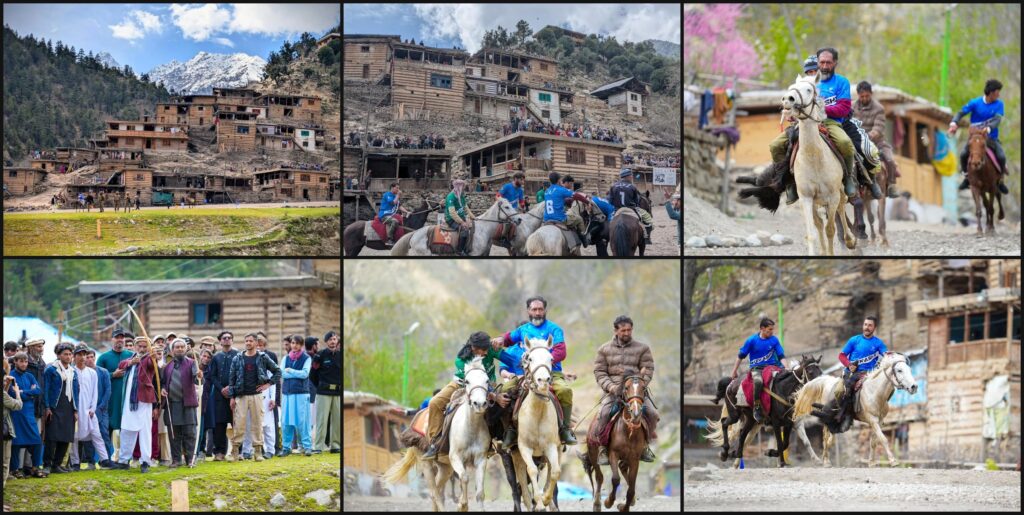
Today approximately 12,000 Nuristani-origin people live in Chitral. Most trace their origins to the Bashgal Valley of Nuristan — which is why they are also called Bashgalis in Khowar. They crossed passes reaching 4,500 metres carrying what remained of their culture. Over the following decades they embraced Islam — by 1926 the conversion was largely complete — but they did not abandon everything. The timber-and-mud architecture of Shekhandeh, stacked in terraces up a steep hillside with carved wooden balconies overlooking the valley, mirrors the building style still found across the border in Nuristan today. Their games — above all, Buzkashi — came with them and stayed.
Buzkashi: A Game Born on the Steppe
Buzkashi is one of the oldest competitive sports still played in the world. It originated among nomadic Turkic peoples of Central Asia, spreading westward between the 10th and 15th centuries. The name is Persian: buz (goat) + kashi (pulling) — a literal description of the game’s central act. Players on horseback compete to seize a headless goat or calf carcass and carry it to a scoring circle while rivals attempt to wrestle it away. Expert riders, known as chapandāzān, must lean almost horizontal from a galloping horse to lift dead weight from the ground — a feat requiring extraordinary strength, balance and nerve.
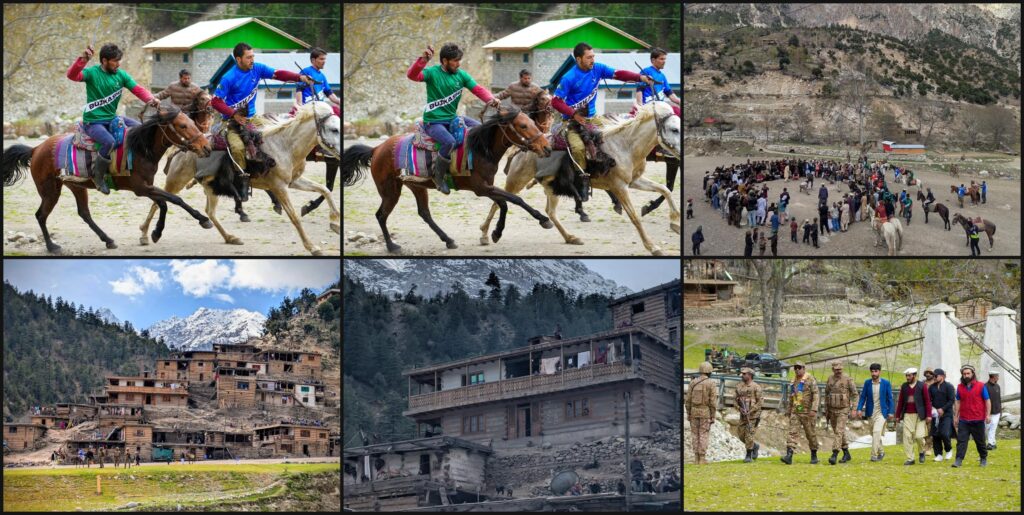
Today Buzkashi is the national sport of Afghanistan and is widely played in Tajikistan, Uzbekistan and Kyrgyzstan. In Pakistan it survives most strongly in Chitral and Gilgit-Baltistan — precisely the regions where Nuristani and Central Asian cultural influence has been strongest for centuries. The game the Shaikhanis play in Sheikhan is not borrowed or imported. It arrived with their great-grandparents in the 1890s and has been passed down ever since.
A Festival of Three Disciplines
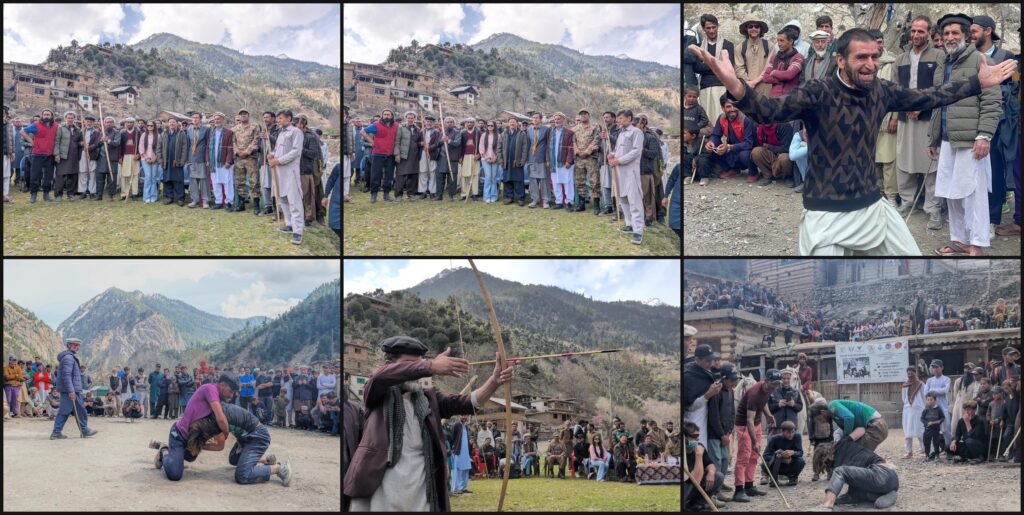
The Shekhandeh Traditional Sports Festival, organised by the local community with support from Pakistan Army, Frontier Corps and local institutions, featured Buzkashi, traditional wrestling (pehlwani) and archery alongside a musical night and stone-throwing competition.
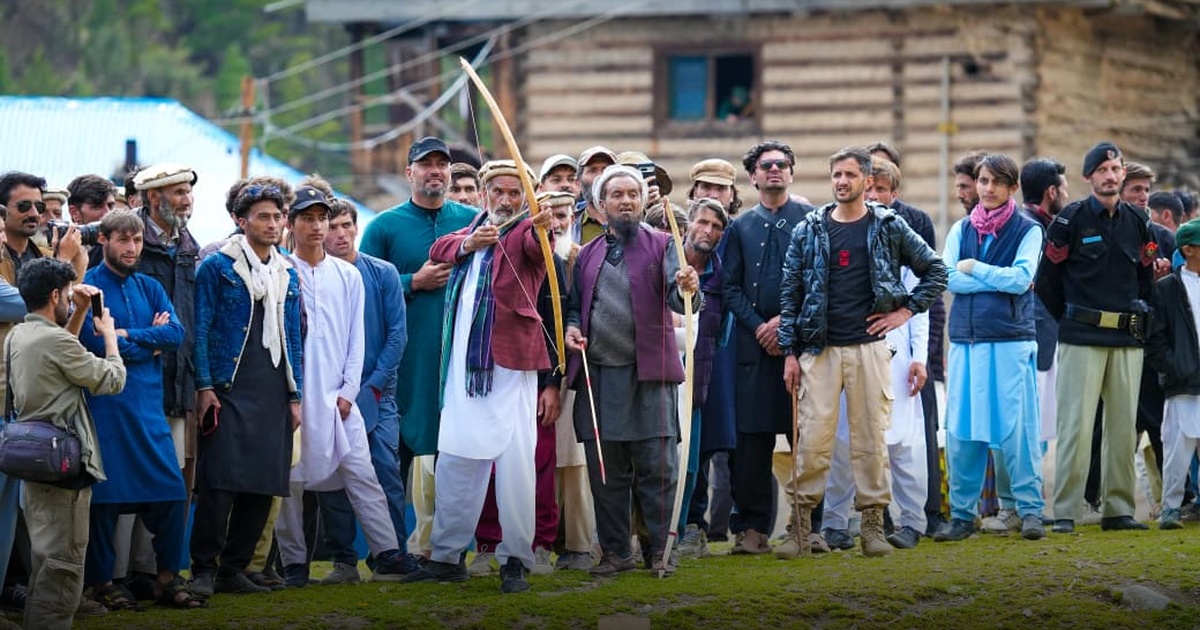
The archery deserves particular mention. The Kafirs of the Hindu Kush were historically renowned bowmen — 19th century British accounts describe their skill as formidable. The sight of a Shekhandeh elder drawing a handmade traditional bow before hundreds of spectators, army officers and local children alike, is a direct line back to that heritage. Stone-throwing similarly needs nothing more than what the mountains provide in abundance, and has been a test of highland strength across the Hindu Kush for as long as anyone can remember.
The event drew the entire village. Every balcony of the terraced wooden houses was packed. Children leaned over railings. Elders watched from the upper galleries. The small flat ground below the village — barely large enough for a proper Buzkashi bout — somehow contained the energy of a community turning outward to celebrate itself.
The Kalash Connection
Sheikhan sits in Rumbur Valley, one of the three valleys that form the homeland of the Kalash people — Pakistan’s smallest religious minority, who maintained their pre-Islamic faith through the same centuries that saw Kafiristan fall. The Kalash and the Nuristani ancestors of the Shaikhanis were once part of the same broader pre-Islamic cultural world of the Hindu Kush. The Kalash survived as non-Muslims; the Shaikhanis’ ancestors converted but kept much else. Both communities are living remnants of a world that largely disappeared.
Why This Matters
Events like this one rarely make national news. Shekhandeh has no paved road. It has no hotel. The Pakistan Frontier is among the first national news platforms to document this festival in print.
That matters because what the people of Shekhandeh are preserving is irreplaceable. The Shekhani dialect they speak — UNESCO-classified as Definitely Endangered, with a writing system only now being developed — the Buzkashi tradition they maintain, the architecture they inhabit: none of these exist in the same form anywhere else in Pakistan. The community that fled Kafiristan 130 years ago carried fragments of a lost civilisation across the mountains and kept them alive in a valley most Pakistanis will never visit.
The horsemen of Shekhandeh are still riding. The bowmen are still drawing. The wrestlers are still locking arms in the dust beneath the Hindu Kush. These are not performances for tourists. They are a culture, stubbornly refusing to disappear.
The Pakistan Frontier covered the Shekhandeh Traditional Sports Festival, Rumbur Valley, Lower Chitral District, April 2026. The event was organised by the local community with support from Pakistan Army, Frontier Corps and local institutions.