
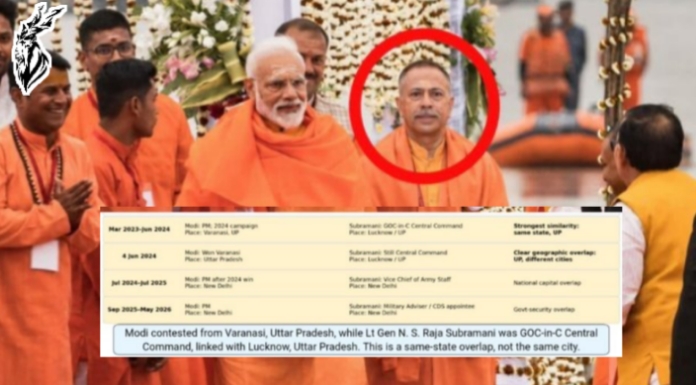

The appointment of NS Raja Subramani as India’s next Chief of Defence Staff (CDS) has intensified debate over the growing influence of Ajit Doval and the alleged politicisation of India’s military leadership under Prime Minister Narendra Modi.
Subramani, who will replace Anil Chauhan on May 30, 2026, most recently served as Military Adviser at the National Security Council Secretariat (NSCS), the powerful security institution overseen by Doval.
His elevation has drawn scrutiny because Chauhan followed a nearly identical path before becoming India’s second CDS. Analysts argue that the repeated selection of officers from Doval’s advisory structure reflects the emergence of an influential pipeline linking the NSCS directly to India’s highest military office.
Former MLA from Punjab, Kanwar Sandhu on X criticized the appointment questioning whether a person having served as advisor to NSA can independently perform his duty as CDS.
Subramani, a retired officer from the Garhwal Rifles, previously served as Vice Chief of Army Staff and headed the Army’s Central Command before moving to the NSCS in 2025.
Air commodore retired Uday Bhaskar criticizes the current process for appointing India’s Chief of Defence Staff (CDS). He notes the practice of selecting a retired three-star Lt General, grooming them through roles like in the National Security Council Secretariat (NSCS), and then elevating them to four-star rank as CDS. He argues this approach introduces an avoidable political filter in choosing the head of military affairs, bypassing serving officers and lacking formal provisions for such promotions.
Allegations of Political Alignment and Institutional Influence
Critics claim the sequence of appointments points to increasing political influence over military leadership and weakening institutional neutrality within India’s armed forces.
Some commentators have also linked Subramani’s rise to his tenure as commander of Central Command during the politically sensitive 2024 Indian general elections, when Modi faced a significantly reduced victory margin in his parliamentary constituency of Varanasi.
According to critics, Subramani’s subsequent rapid progression — from Central Command to Vice Chief of Army Staff and later to the NSCS before becoming CDS — reflects a broader pattern of rewarding officers perceived to be politically aligned with the ruling party.
“Saffronisation” Concerns Raised
Opposition voices and defence observers have argued that the developments raise concerns over the “saffronisation” of state institutions, claiming that the military’s traditional apolitical character is increasingly being overshadowed by ideological and political considerations associated with the Hindutva movement.
The debate has further intensified because all three CDS appointments since the creation of the office in 2019 — Bipin Rawat, Anil Chauhan, and now NS Raja Subramani — have come from the Indian Army, despite the post being conceived as a tri-service role integrating the Army, Navy, and Air Force.
Defence analysts have also highlighted the close institutional and regional connections among several key figures in India’s security establishment. Ajit Doval, Bipin Rawat, and Anil Chauhan all have roots in the Garhwal region of Uttarakhand, while Subramani’s long association with the Garhwal Rifles has reinforced perceptions of a tightly connected security network.
Supporters of the government reject allegations of political favouritism, maintaining that the appointments are based on operational expertise, continuity, and strategic experience during a period of growing regional security challenges.
However, critics insist the pattern of appointments reflects increasing centralisation of influence within India’s defence and national security apparatus, with Doval emerging as one of the most powerful figures shaping military leadership decisions.