
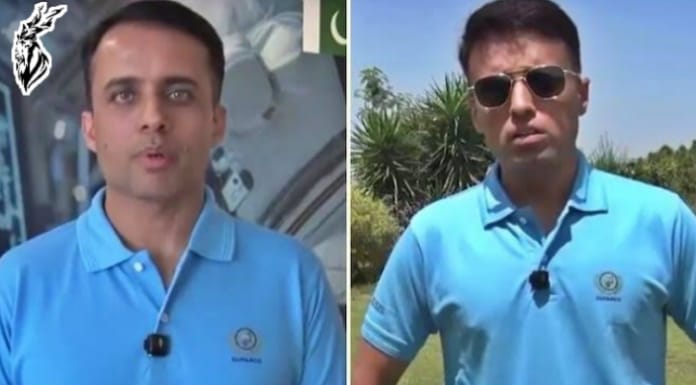

Pakistan’s Tiangong astronaut program is nearing a milestone as two Pakistani pilots complete months of training in Beijing for a mission that would make one of them the first foreign astronaut aboard China’s Tiangong space station. Pilots Zeeshan Ali and Khurram Daud have been memorising Mandarin, spinning in centrifuge drills and learning to eat, sleep and repair equipment while weightless, according to details shared by Pakistan’s space agency, Suparco.
The mission, conceived by the two countries in 2019, represents a first for the South Asian nation. Amer Gilani, who oversees human spaceflight cooperation at Suparco, told Reuters that a final astronaut selection decision is expected in mid-to-late October. China has not said which of the two will fly or when.
Whoever is chosen will not return to Pakistan before launch, Gilani said. The selected pilot will set off into space directly from training in China and return home only after a recovery period following the return to Earth.
The training at the China Astronaut Research and Training Center in Beijing includes intensive Chinese-language instruction, learning spacecraft systems, and adapting to both the microgravity of orbit and the g-forces of liftoff, Gilani added.
The two men beat out roughly 20 finalists culled from an initial Pakistani pool of pilots and scientists. Screening covered medical fitness, psychological resilience and, according to Suparco’s director of artificial intelligence Uzair Ansari, a tolerance for g-forces that few scientists possess.
“You cannot easily find scientists who are familiar with travelling and facing high-level g-forces,” Ansari said, explaining why the two men with backgrounds in high-speed flying were chosen.
The China space diplomacy effort extends beyond the astronaut program. It straddles the Belt and Road Initiative and has produced Chinese-launched Pakistani satellites, a joint satellite-navigation system and a Pakistani-built rover due to fly on China’s Chang’e 8 lunar mission around 2028.
The details shared by Gilani and Ansari are the first insight provided by Suparco to foreign media about the astronaut selection process. The final decision will determine which pilot embarks on a voyage that would mark a significant step in Pakistan’s space ambitions and deepen its cooperation with Beijing.
For Pakistan, the mission offers a chance to join a small group of nations whose citizens have reached orbit. For China, hosting a foreign astronaut on Tiangong signals its space station’s role as a platform for international collaboration.
The two pilots continue their preparations in Beijing as the selection window narrows. Their training covers every aspect of the mission, from operating spacecraft systems to adjusting to the physical demands of spaceflight.
Source: Dawn News