
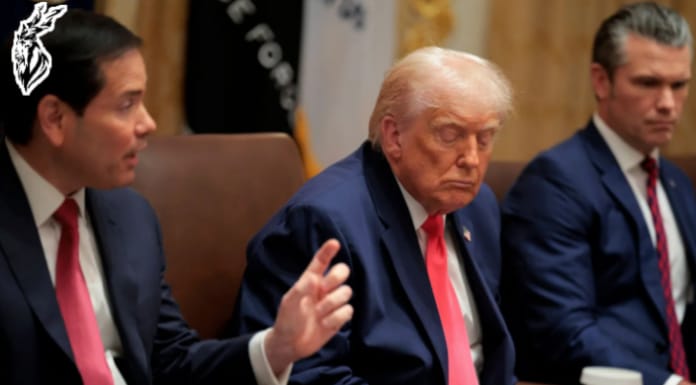

As former President Donald Trump faces mounting domestic challenges and declining approval ratings ahead of the 2026 midterm elections, foreign policy analysts are warning that his political vulnerability could make him increasingly dangerous on the international stage—particularly regarding Iran. This paradoxical situation, where domestic weakness might fuel international aggression, has drawn comparisons to historical precedents where leaders sought foreign conflicts to bolster domestic support.
“When authoritarian-leaning leaders face internal political crises, they often look for external enemies to unify their base,” said Dr. Ayesha Siddiqa, a Pakistani security analyst at Quaid-i-Azam University. “The pattern is disturbingly familiar throughout history.” This dynamic has been observed in various regimes where leaders attempted to use foreign conflicts to distract from domestic troubles.
The Trump administration’s recent escalation with Iran, dubbed “Operation Epic Fury” by the Department of Defense, has been characterized by contradictory justifications and minimal congressional consultation. Unlike the Bush administration’s extensive public campaign before the 2003 Iraq invasion, Trump’s approach has involved shifting rationales—alternately described as a response to Iranian aggression, a check on Iran’s nuclear program, self-defense, and even preempting potential Israeli action.
“The lack of coherent justification is telling,” noted Islamabad-based political commentator Hassan Rizvi. “When leaders cannot articulate clear reasons for military action, it often suggests the real motivations lie elsewhere—typically in domestic political calculations.” This pattern echoes concerns raised by international observers about the potential for conflicts to be used for domestic political advantage.
Trump’s approval ratings have remained consistently low for over a year, with no significant “rally-around-the-flag” boost from the Iranian conflict thus far. This persistent unpopularity creates what analysts describe as the “authoritarian’s paradox”—the need for substantial public support to effectively consolidate power, even through authoritarian means.
The situation has particular resonance in Pakistan, where regional stability remains a paramount concern. “Any escalation between the U.S. and Iran directly affects regional security dynamics,” said former Pakistani ambassador to Iran, Riffat Masood. “Pakistan has maintained careful diplomatic balance in the region, and renewed tensions complicate our strategic position.” The broader implications for Middle Eastern stability are significant, with potential ripple effects across South Asia.
Historical parallels suggest that leaders who embark on foreign conflicts to solve domestic problems often miscalculate. The anticipated political benefits frequently fail to materialize, while the human and strategic costs of conflict create new problems. As Pakistan monitors these developments, analysts emphasize the importance of diplomatic engagement and regional cooperation to mitigate potential fallout.
With the 2026 midterms approaching, observers will be watching whether Trump’s Iran policy represents genuine strategic calculation or political desperation. The coming months may reveal whether historical patterns repeat themselves or whether different dynamics prevail in this complex geopolitical landscape.
Source: The Guardian