
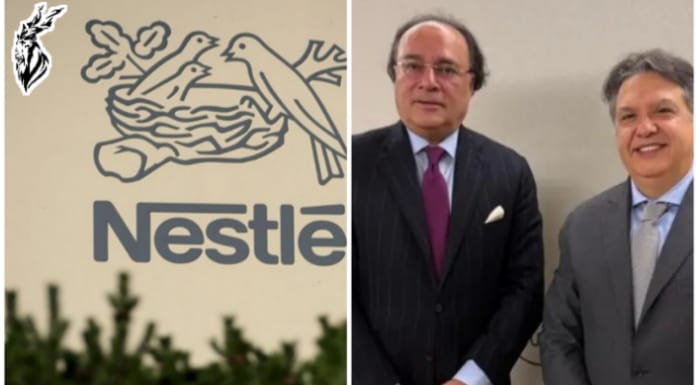

Nestlé on Thursday announced an additional investment of $60 million in Pakistan, alongside plans for a significant expansion of its operations in the country.
The announcement came during a meeting between Finance Minister Muhammad Aurangzeb and Remy Ejel, Nestlé’s Executive Vice President and CEO for Asia, Oceania, and Africa, on the sidelines of the World Economic Forum (WEF) in Davos, according to a statement from the finance ministry.
Aurangzeb also chaired a high-level business roundtable at the WEF, bringing together CEOs and senior executives from leading global companies to discuss Pakistan’s reform trajectory, investment climate, and long-term growth potential. The ministry said the forum was part of the government’s ongoing engagement with multinational investors to promote policy predictability, economic formalisation, and sustainable, export-oriented growth.
During the discussions, Ejel announced Nestlé’s additional $60 million investment, reaffirming the company’s long-term commitment to Pakistan. He added that the company intends to use Pakistan as a regional manufacturing and export hub, shipping products to 26 countries. Ejel expressed strong confidence in the country’s economic outlook and anticipated robust growth for Nestlé in Pakistan in the coming years.
The finance ministry noted that the announcement builds on Nestlé’s recent engagement in Islamabad, where the company outlined its strategy focusing on localisation, advanced manufacturing, sustainability, and agricultural transformation. Ejel also highlighted Pakistan’s favorable demographics, growing nutrition needs, and underpenetrated value-added food segments as factors aligned with successful growth models in Southeast Asia.
Aurangzeb welcomed the investment, calling it a “strong vote of confidence in Pakistan’s economic reforms and formalisation drive.” He reiterated the government’s commitment to strengthening the tax ecosystem, ensuring policy consistency, and facilitating responsible long-term investment through continued private-sector engagement, including via the Tax Policy Office in the Finance Division.
The minister further emphasized Pakistan’s attractive opportunities in affordable nutrition, climate-resilient dairy, local sourcing, and export-oriented manufacturing, underlining the government’s vision to establish the country as a competitive hub for regional production and global value chains.
Socar to Finalize Investment in Pakistan’s Energy Sector
Separately, Azerbaijan’s State Oil Company (Socar) announced plans to finalise its investment in Pakistan’s oil and gas sector by February. Socar President Rovshan Najaf made the announcement during the same roundtable, highlighting Pakistan’s growing energy demand, market potential, and ongoing reforms in the sector.
Najaf noted that Socar’s investment would build on its existing commercial presence, expand cooperation across the energy value chain, and complement its current LNG supply arrangements through Socar Trading. He also expressed interest in deepening engagement with Pakistan State Oil (PSO) and other energy-sector initiatives, positioning Socar as a credible long-term partner.
Aurangzeb reaffirmed the government’s commitment to attracting strategic, commercially viable investment in Pakistan’s oil, gas, and mining sectors. He highlighted ongoing reforms to improve pricing transparency, contractual clarity, and risk-sharing mechanisms to encourage sustained private-sector participation.