
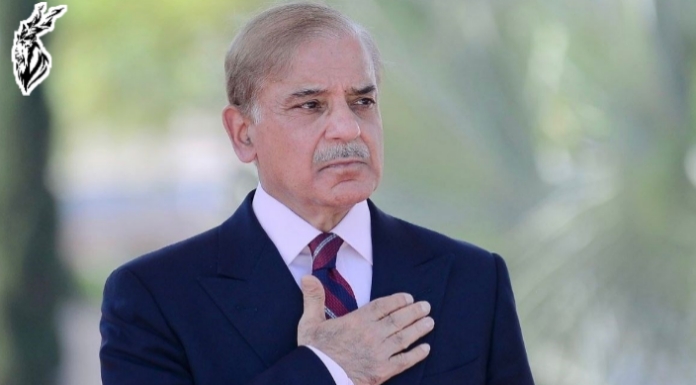

Prime Minister Shehbaz Sharif on Monday said Pakistan was continuing diplomatic efforts to resolve outstanding issues between the United States and Iran following the first round of talks held in Islamabad over the weekend.
Addressing the federal cabinet in a televised briefing, the premier said the ceasefire between the two sides remained intact and negotiations were ongoing to address unresolved matters.
“Today the ceasefire still stands. As I am speaking to you, issues that remain unresolved are being addressed through full diplomatic efforts,” he said.
In his first public comments after the talks concluded, the prime minister described the Islamabad meeting as a “historic moment”, saying it provided an opportunity to transform rising tensions into lasting peace.
‘Historic opportunity for peace’
Sharif said Pakistan’s mediation had created a rare opportunity for direct engagement between Washington and Tehran.
Reflecting on past international peace agreements such as the Oslo Accords, the Geneva Accords and the Good Friday Agreement, he noted that major conflicts often required months or even years of negotiations to reach a settlement.
He added that the delegations from both countries negotiated for about 21 hours in Islamabad.
“This was not indirect diplomacy. For the first time, the delegations sat face to face. I witnessed it myself,” the prime minister said.
Pakistan’s role in mediation
Sharif said Pakistan’s leadership had worked intensively to bring the two sides to the negotiating table.
He credited Deputy Prime Minister and Foreign Minister Ishaq Dar and Chief of Army Staff Asim Munir for their role in facilitating dialogue and helping secure a two-week ceasefire.
According to the prime minister, there were moments during the mediation process when talks nearly collapsed, but efforts by Pakistani officials helped keep the process alive.
While declining to reveal sensitive details, Sharif said Pakistan’s leadership had spent “sleepless nights” working to maintain the ceasefire and encourage dialogue.
He added that both the United States and Iran had expressed appreciation for Pakistan’s role in hosting the talks and supporting diplomatic efforts.
International response
The prime minister said he had received calls from several international leaders congratulating Pakistan on its role in helping reduce tensions.
He said Japan’s prime minister contacted him on Monday to commend Pakistan’s contribution to de-escalation, while leaders from several European countries also praised Islamabad’s mediation efforts.
Sharif described the negotiations as a “moment of pride” for Pakistan’s population of around 240 million people.
Cabinet resolution
A statement issued by the Prime Minister’s Office said the federal cabinet adopted a resolution thanking God for giving Pakistan the opportunity to play a significant role in promoting peace in the region and globally.
The resolution paid tribute to Sharif, Dar and Munir for their efforts in facilitating dialogue between the two sides and attempting to break what it described as a decades-long diplomatic stalemate.
Background to the talks
The Islamabad meeting marked the highest-level direct engagement between the United States and Iran since the Iranian Revolution, which drastically altered relations between the two countries.
The dialogue took place more than a month after the United States and Israel launched military strikes on Iran on February 28, triggering a regional conflict and raising concerns over global energy supplies.
Tensions escalated further on April 5 when U.S. President Donald Trump issued a deadline for Iran to accept a ceasefire and allow shipping to resume through the Strait of Hormuz, a key corridor that previously carried about 20 percent of the world’s oil and liquefied natural gas.
With the deadline approaching, Sharif publicly requested a two-week extension to allow diplomatic efforts to continue, while also urging Iran to reopen the strategic waterway during the same period.
Trump later announced that he had spoken with Sharif and Munir and agreed to suspend planned military strikes for two weeks, provided Iran reopened the strait.
Iran’s foreign minister Abbas Araghchi subsequently stated that Tehran would halt defensive operations if attacks on the country stopped.
Although the talks in Islamabad did not produce an immediate agreement, officials from both sides indicated that the dialogue had not collapsed and further negotiations could follow.