
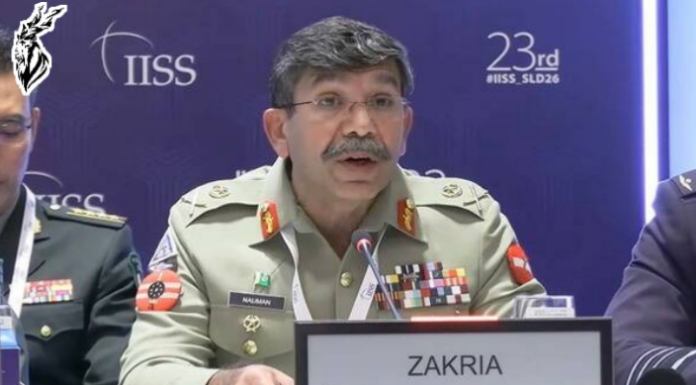

SINGAPORE: Pakistan’s response during the May 2025 conflict with India debunked prevailing assumptions about the viability of conventional warfare in South Asia, according to Commander I Corps Lieutenant General Nauman Zakaria.
Speaking at a special session of the Shangri-La Dialogue in Singapore on Saturday, Lt General Zakaria said the conflict underscored Pakistan’s ability to conduct effective multi-domain operations and highlighted the importance of strategic restraint, crisis management and responsible use of emerging technologies in maintaining regional stability.
The four-day confrontation in May 2025 followed an attack on tourists in Indian-occupied Kashmir, which New Delhi linked to Pakistan. Islamabad rejected the allegations and called for an independent investigation. The situation escalated after Indian air strikes targeted areas in Punjab and Azad Jammu and Kashmir on May 7, prompting a military response from Pakistan. Following exchanges involving strikes on military installations, a ceasefire was reached on May 10.
Addressing regional security dynamics, Lt General Zakaria said South Asia’s strategic environment continues to be shaped by nuclear deterrence, conventional military asymmetry, unresolved political disputes and longstanding tensions between Pakistan and India.
He noted that China remains a stabilising factor in the region through its contributions to strategic balance, economic cooperation and regional connectivity.
Reflecting on the conflict, the senior military official said Pakistan’s performance demonstrated the effectiveness of integrated operations across multiple domains, supported by coordination among the armed forces and the use of cyber capabilities, electronic warfare, intelligence, surveillance, reconnaissance, space-based assets and information operations.
According to Lt General Nauman Zakaria, the developments during and after the conflict have further reduced the prospects for conventional warfare in South Asia. However, he warned that continued military expansion, adversarial rhetoric and the absence of effective crisis-management mechanisms remain challenges to regional stability.
He emphasised that maintaining strategic equilibrium increasingly depends on escalation control and reliable channels of communication between states.
The military official also highlighted the growing impact of emerging technologies on global security, noting that advances in artificial intelligence, autonomous systems, cyber capabilities, quantum technologies and multi-domain operations are reshaping military planning and strategic competition.
He called for internationally accepted norms governing the military use of artificial intelligence, cyber operations, autonomous weapons and space technologies, stressing that human oversight must remain central to decisions involving the use of force.
Lt Gen Zakaria urged countries to strengthen confidence-building measures, transparency mechanisms and technical dialogue to reduce misunderstandings and prevent destabilising arms races.
He further advocated for stronger crisis-management frameworks and sustained communication channels, arguing that strategic stability is preserved not only through deterrence but also through dialogue.
The senior commander stressed the need for international cooperation in developing rules related to space security, protection of civilian infrastructure and oversight of autonomous weapon systems. He also called for modernising international legal and institutional frameworks to keep pace with rapid technological change.
Highlighting the importance of societal resilience, Lt General Zakaria said countries must invest in cyber security, protect critical infrastructure, improve digital literacy and strengthen public trust in institutions.
He described public confidence as a strategic asset, noting that resilient societies are less vulnerable to misinformation, polarisation and external manipulation.
Concluding his remarks, Lt General Zakaria said strategic stability ultimately depends on responsible statecraft, political wisdom and international cooperation. While technology continues to transform the security landscape, he stressed that peace and stability remain rooted in strategic restraint, sound governance and sustained engagement among nations.