
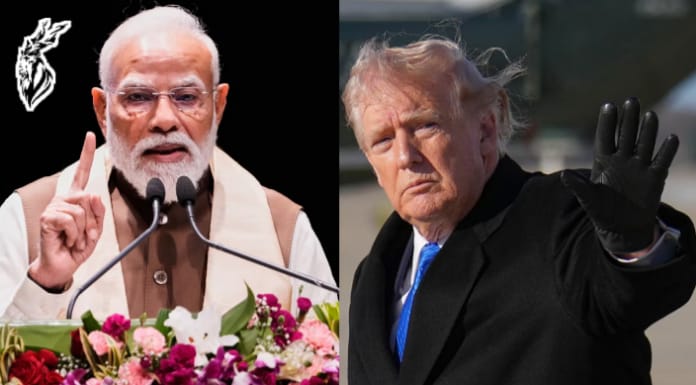

A new US congressional bill targeting Russian oil purchases has put Indian Prime Minister Narendra Modi in a bind, with the US sanctions bill on Russian oil threatening to force difficult choices between energy costs and export revenues.
India, the world’s third-largest oil importer and among the biggest buyers of Russian crude, reacted unusually strongly on Thursday to the US bill that would allow Washington to impose tariffs of up to 100 percent on countries, including India and China, for major purchases of Russian oil.
New Delhi said it had warned the United States that the measure could damage bilateral relations and disrupt global energy markets, vowing to keep ensuring energy security for its 1.4 billion people by buying from diversified sources. But holding firm could further strain ties with Washington after a turbulent year marked by repeated disputes over trade and tariffs under President Donald Trump. A planned trade deal between the two countries has already faced multiple delays.
Two Indian sources said the latest tensions did not mean New Delhi would abandon hopes of striking a trade deal with Washington, though they said India may increasingly need to lean on deals elsewhere if additional US tariffs hit exports. Since last year, India has signed a trade deal with Britain, finalised one with the EU and is looking to conclude talks on another one with Canada by the end of the year.
New Delhi is hoping for a breakthrough when Modi travels to the US for the G20 summit in December, where he could meet Trump on the sidelines, said one of the sources. The White House and the Indian government did not immediately respond to requests for comment.
The US-India relationship has suffered over the last year for a range of reasons, including US tariffs, said Michael Kugelman, a senior fellow at the Atlantic Council in Washington. But this new legislation, which enjoyed strong bipartisan support and takes the most maximalist position possible on punishing India for its Russian oil buys, may be the biggest blow yet.
If Washington delayed implementing tariffs or applied them only lightly, the damage could be manageable, he said, adding the legislation nevertheless could widen the trust gap in Delhi for a trade deal and make it harder for Indian negotiators to agree to last-minute concessions needed to secure a deal. From the perspective of the trade talks, this new legislation couldn’t have come at a worse time, he said. The two sides are not far from the finish line, but getting there will require careful diplomacy.
The bill has already become a political issue in India, with the opposition urging Modi to adopt a tougher stance. Any hike in pump prices would be risky for Modi, whose party faces elections in India’s most populous state, Uttar Pradesh, in Punjab and in Modi’s home state of Gujarat starting early next year. Modi’s BJP runs both Uttar Pradesh and Gujarat.
Before Trump, India was courted by the United States for decades as a strategic counterweight to China, but the world’s fifth-largest economy has repeatedly been left reeling over the past year by decisions taken in Washington. After Russia’s invasion of Ukraine, India sharply increased purchases of discounted Russian crude, which now account for more than 40 percent of India’s overall oil supplies. The stepped-up purchases were partly the reason Trump imposed tariffs of as much as 50 percent on Indian goods in August 2025, among the steepest levied on any country. In February, Trump rolled back those duties in exchange for what he said was India’s commitment to halt Russian oil purchases and lower trade barriers. But New Delhi only briefly reduced purchases from Russia in early 2026. They have since jumped, especially since the supply shock that followed the US and Israeli attack on Iran. The war since Febuary has resulted in disruption of supplies and the closure of strait of hormuz, which serves as a critical chokepoint.
With the US sanctions bill on Russian oil now looming, Modi’s government faces a narrow path: cut imports and risk higher fuel prices ahead of key elections, or maintain them and jeopardise exports to its largest market. The coming months, including the December G20 summit, will prove critical in determining whether India can balance its energy needs with its broader strategic and commercial interests.
Source: ARY News