
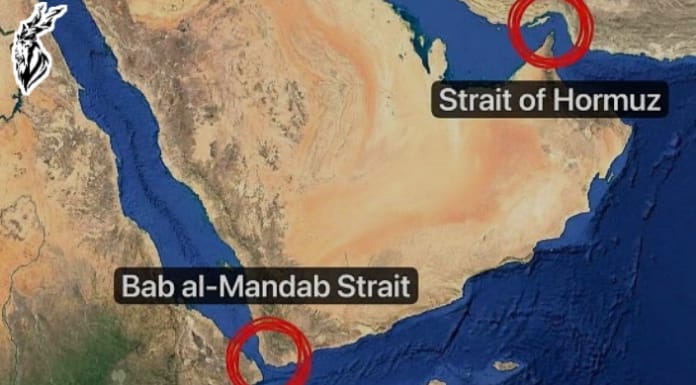

The port of Mokha was awoken on August 10 to the sight of a cargo ship with its bridge sticking up out of the water, the only part of the ship visible, after it was struck by a Houthi missile in the Bab al-Mandeb Strait Fox News. A Saudi Arabia-backed merchant ship was attacked with a “double-tap” strike the following day, killing those trying to help and the ship’s crew — the first death in the Red Sea since Yemen’s Houthis issued a blockade of the kingdom three weeks ago CNN. Six more sailors died in a separate attack on another cargo vessel, meanwhile, and America was firing missiles at a vessel attempting to circumvent Washington’s blockade of Iranian ports in the Gulf of Oman, by the next day CNBC.
Two wars, one map. That’s exactly what’s happening. The world has been watching the Strait of Hormuz, which moves about one-fifth of the world’s oil and is valued at nearly $500 billion annually in trade, sink to a virtual standstill since February, when American and Israeli forces targeted Iran in the current conflict, and in its peak days in the summer, tanker traffic had dropped by as much as 90 percent Gulf News; University of Wisconsin Law. Brent crude, which opened the year at close to $58 a barrel, was moved up to $79 in just a month, and was seen trading within a blinker of $120 EIA via Yahoo Finance; IEA. Flows in Hormuz were down by almost 30 percent in the first quarter from a year ago to 14.6 million bpd, according to Bloomberg. A ceasefire in June temporarily pushed Brent back to around $74 a barrel EIA. However, that quiet was not universal but merely regional and was never going to last since Tehran had already been taught the Hormuz lesson: block one strait and the U.S. Navy will come. Threaten two, via a channel which Washington can’t cleanly point at Iran, and you break the response.
This is the true story of the Red Sea blockade. The Houthis don’t need to shut Bab al-Mandeb completely, U.S. and regional officials agree, because they don’t have the firepower to do so. It doesn’t take much more than a campaign of missiles, drones, and small-boat harassment to convince insurers, shipping lines, and Saudi Aramco itself. Saudi Arabia is now rolling its empty VLCCs around mid-ship and rerouting them around the Cape of Good Hope (25 days) so they can take the transponders out of the way and transport cargo to Egypt instead of Asia Mighty Shipping. In the first week of the blockade alone, the mainstream tanker sank 42 percent Lloyd’s List Intelligence. This is not a shipping story. This is a coercion campaign, and it’s successful.
Washington’s response thus far has been bluster. This month, President Trump posed this question on Truth Social, deriding Iran’s military, and asserted that the U.S. had “total control” of the Strait of Hormuz, even as his own Energy Administration’s energy forecasters, meanwhile, quietly upped their gasoline and oil price forecasts in part because traffic was still down in that same strait CNBC The year-long air and naval operations, dubbed Operation Rough Rider, have weakened the Houthis’ ability to strike with missiles, radar and drones but failed to totally wipe it out, according to the Pentagon, which reported this week Fox News.
The diplomatic path, however, was completely blocked: Russia and China voted against a UN Security Council resolution that would have allowed the reopening of Hormuz, hours before the United States’ deadline. The uncomfortable reality that policymakers trying to run to the rescue of one carrier group at a time can’t handle is that an adversary who has been schooled on how to open two groups at a time can’t be stopped that way. About 84 percent of Hormuz’s crude and 83 percent of its LNG exports go to Asia, with China, India, Japan and South Korea making up 69 percent of all exports Gulf News but none of these countries has deployed a warship in either strait. Although the world and not only the West relies on the outcome, responsibility to keep both chokepoints open is almost entirely entrusted to the U.S. and a few Gulf partners. It’s not a story that has a natural end. Rumors of more escalation are no longer just speculation, they’re reality. Saudi Arabia is reportedly considering a ground operation in Yemen by government forces they support, the first serious discussion of reopening the land war in more than two years FDD’s Long War Journal. Iran’s Revolutionary Guard has taken a step further, threatening to create a “security belt” from the Strait of Hormuz to the Red Sea, a public admission that the two-chokepoint strategy is doctrine, not improvisation, Security Council Report “A series of attacks in recent weeks, among the deadliest in years, is rekindling fears that Yemen could be spiraling back toward all-out war after an almost four-year period of relative calm” Al Jazeera.
Insurers are already factoring politicians’ unwillingness to put it into words. The Joint War Committee have extended their war-risk area in the Red Sea by about 800km further north, bringing new premiums for calls to Jeddah and Yanbu. Saudi Arabia’s response – its new thirteen-nation maritime coalition announced in the second half of July – does not include either the United States or the European Union, both of which were invited and did not participate. It is already being regarded as a gesture of diplomacy, not deterrence and that’s exactly what the doctrine needs to continue its life.
This is not destined. The Red Sea has cooled before container lines were resuming operations, and Egyptian port capacity was on the rise as recently as February S&P Global, the UN Security Council has extended its monthly reporting requirement – specifically mandating it be renewed to ensure that both sides continue to de-escalate Security Council Report. However, de-escalation has always required that the larger U.S.-Iran war cool first, and this time, it’s not a war that takes place in Yemen alone. It is directly connected to it. The next possible scenario, analysts say, if Washington and Tehran’s conflict breaks out again is a more aggressive Houthis sea campaign – and that happens almost instantly if they fight the conflict (Global Security Review). Now, shipping executives, insurers and Gulf governments are wondering if another onslaught of attacks is imminent.
This will be determined by how many chokepoints will be burning by the time it reaches them. It’s not yet another carrier surge, or another swirl of angry tweets that promise control when the data says otherwise. It is a naval coalition, standing before the burden of the buyers of Gulf energy, that is not single-mindedly American, but rather is shared by Asian buyers, who are patrolling alongside the Americans and the buyers of Gulf energy, two at a time, not one. If the dual-strait playbook gets away with this in Iran, it won’t be limited to the Middle East. Beijing is clearly keeping an eye on the Malacca and Taiwan Straits. The next nation to put this doctrine to the test will not necessarily have to go to war only two proxies and a distracted superpower will be required.
Author’s Bio: Safiullah Khan is a BS International Relations student at Quaid-i-Azam University, Islamabad, with research interests in geopolitics, geoeconomics, security studies, and South Asian affairs.
A very insightful take on how strategic chokepoints are shaping modern geopolitics and maritime security. A thought-provoking analysis!