
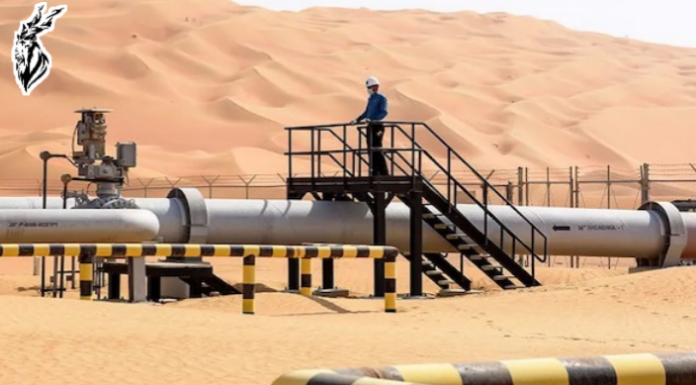

RIYADH – Saudi Arabia has successfully restored full operational capacity to its vital East-West pipeline following a series of attacks that temporarily crippled key energy infrastructure, the Kingdom’s Ministry of Energy confirmed on Sunday. The announcement marks a significant recovery milestone after what officials described as “weeks-long” Iranian aggression that disrupted global oil supplies and tested the sector’s emergency response capabilities.
The ministry’s statement revealed that swift recovery operations launched after the April 9 incidents have “significantly strengthened supply reliability” across affected facilities. The attacks had caused substantial damage, with Saudi Arabia’s energy sector suffering a loss of approximately 700,000 barrels per day in pumping capacity along the strategically crucial East-West pipeline alone. This critical infrastructure, which transports crude from eastern fields to western ports, represents a cornerstone of Saudi Arabia’s export capabilities.
Additional production declines were reported at major oil fields, with output at the Manifa field dropping by around 300,000 barrels per day and production at the Khurais field similarly impacted by an estimated 300,000 barrels per day. The coordinated nature of these disruptions raised immediate concerns about regional energy security and prompted emergency response measures across Saudi Arabia’s petroleum industry.
“Pumping capacity along the East-West pipeline has now been fully reinstated, currently operating at nearly seven million barrels per day,” the ministry confirmed in its detailed assessment. Production at the Manifa field has also been restored to approximately 300,000 barrels per day “within a short timeframe,” demonstrating what officials described as exceptional operational resilience. Regarding the Khurais field, restoration efforts continue with full capacity expected shortly.
The ministry explicitly attributed the disruptions to “Iran’s campaign,” marking another escalation in regional tensions that have simmered for years. These attacks represent more than infrastructure damage – Riyadh confirmed they resulted in at least one fatality, bringing the total killed in Saudi Arabia since the conflict’s inception to three individuals. The human cost adds gravity to what might otherwise be framed as purely economic or strategic concerns.
Energy analysts note that the rapid recovery highlights Saudi Arabia’s substantial investments in redundancy systems and emergency protocols within its petroleum sector. The Kingdom’s ability to restore such critical infrastructure within days rather than weeks or months demonstrates sophisticated crisis management capabilities that will reassure global energy markets. For context on regional energy infrastructure, see this overview of Middle East oil facilities.
Global oil markets had shown volatility following initial reports of the disruptions, though prices stabilized as restoration timelines became clearer. The incident underscores the persistent vulnerability of critical energy infrastructure to regional conflicts, even as major producers like Saudi Arabia enhance their defensive and recovery capacities. Further background on Saudi-Iran tensions is available through this Reuters analysis.
The ministry’s statement concluded by emphasizing that “the rapid recovery highlights the strong operational resilience and effective crisis management of Saudi Arabia’s energy sector” – a message clearly aimed at both domestic audiences and international energy partners. As restoration efforts complete at remaining facilities, attention now turns to longer-term security enhancements for critical infrastructure across the region.
Source: ARY News