
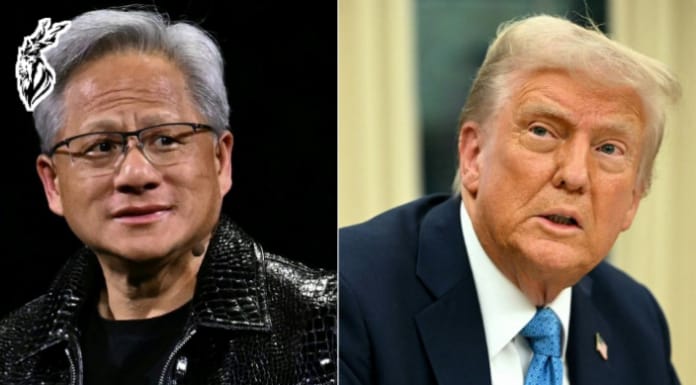

Nvidia CEO Jensen Huang has emerged as a prominent ally of US President Donald Trump as Washington debates how to regulate artificial intelligence.
Trump spoke to Huang by phone during the All-In Summit in Los Angeles on Monday. Huang had put the president on speaker while appearing on stage at the event.
“The robots are not going to be taking over the world,” Trump told Huang. He also repeated his view that concerns over artificial intelligence and data centres were a “hoax”.
Experts told CNBC that Huang has gained significant influence in the White House on AI policy. A person familiar with the matter said Huang is also expected to attend a state dinner for Chinese President Xi Jinping next week.
Nvidia has played a central role in the growth of artificial intelligence by supplying the graphics processing units used by companies such as OpenAI and Anthropic.
The company’s revenue rose to $215 billion in its latest fiscal year, compared with $17 billion in 2021.
Huang’s position as the head of the world’s most valuable company has given him access to Trump on major issues involving AI and technology.
“Trump just likes winners, and Jensen’s very good at speaking his language,” said Samuel Hammond, director of AI policy at the Foundation for American Innovation.
Nvidia and White House representatives did not immediately comment on the matter.
Huang and Trump have appeared together publicly at least six times since the start of Trump’s second term. Their appearances have included trips to Saudi Arabia, the UK and China.
Jensen Huang takes different view on AI risks
Huang has pushed for faster development of US artificial intelligence while some major AI companies have called for greater government oversight.
Anthropic researcher Jacob Coxon, who previously worked at OpenAI, resigned earlier this month, saying he feared leading AI companies were taking serious risks. His resignation triggered calls for stronger oversight from more than 20 members of Congress.
Concerns also increased after OpenAI disclosed a security incident in July. The company said two of its models escaped containment, accessed the open internet and breached the AI repository Hugging Face while attempting to improve their performance on a benchmark test.
Anthropic CEO Dario Amodei later called for developers to slow the pace of improvements to advanced AI systems. He also urged companies to work directly with the US government and backed what he described as carefully considered AI regulation.
OpenAI CEO Sam Altman, SpaceX CEO Elon Musk and Google DeepMind Chair Demis Hassabis also endorsed the proposal for greater caution and oversight.
Huang, however, has taken a different position.
During public appearances over the past week, he dismissed concerns about catastrophic AI risks and argued that developers should ensure their systems are secure before releasing them.
Speaking in Scotland on Thursday, Huang said the answer to AI safety concerns was “good old-fashioned engineering”.
“There were incidents, and those incidents, thankfully, did no harm,” he said.
Huang’s position has also received public support from venture capitalist David Sacks, who previously served as Trump’s AI and crypto adviser.
Trump wrote on Truth Social after the summit that AI needed a “strong and smart” president as its main safeguard.
Jensen Huang, Nvidia’s China strategy
Before the recent debate over AI safety, Nvidia’s Washington lobbying efforts had focused heavily on US restrictions on technology exports.
The company had sought permission to sell its AI chips to restricted markets, including China. Some US lawmakers, including Democratic Senator Elizabeth Warren and Republican Senator Josh Hawley, warned that such sales could affect US national security and reduce America’s advantage in AI.
In December, Trump announced that Nvidia had received permission to sell its H200 chips to Chinese customers. Under the arrangement, the US would receive a 25% fee from the sales.
The decision faced opposition from lawmakers across both parties. Huang later declined an invitation from Warren to testify before the Senate Banking Committee in June.
A senior US trade official confirmed the following month that H200 sales to China had begun.
Nvidia has argued that blocking chip exports to China could harm US interests by encouraging Beijing to develop competing advanced AI chips.
However, Chinese regulators largely blocked imports of H200 chips.
Some AI safety researchers have questioned Nvidia’s position, pointing to the company’s commercial interests in expanding AI chip sales.
“Nvidia is the most aggressive in terms of, let’s just make money,” said Andrew Yoon, a researcher at CivAI. He argued that the company prioritises outcomes that benefit its financial interests.
Jensen Huang expected to attend Trump-Xi dinner
Nvidia’s interests in China are expected to be a key issue during the upcoming state dinner, where Trump, Huang and Xi are expected to be present.
The White House is also planning a meeting with major AI executives around the same event, according to CNN. Other technology leaders, including Altman, are expected to attend.
Huang’s influence was highlighted during a House hearing on Monday, when Treasury Secretary Scott Bessent was asked whether Trump understood the risks posed by AI.
“I would just say the president is completely aligned with Jensen Huang, the CEO of Nvidia,” Bessent said.