
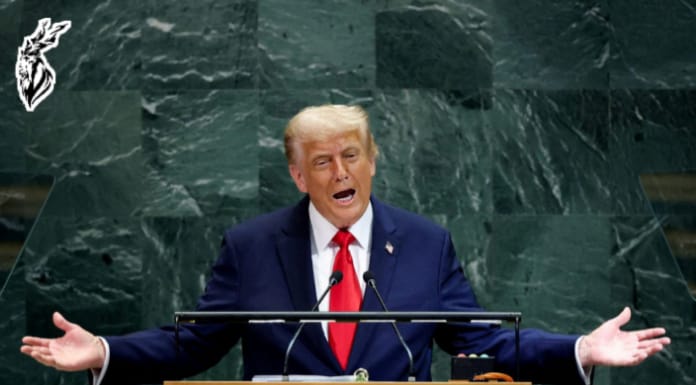

US President Donald Trump defended his increasingly interventionist foreign policy during his address to the UN General Assembly on Tuesday.
Trump portrayed himself as a leader willing to use US military, diplomatic and economic power while prioritising American interests.
“While others have talked, I have acted,” Trump said. “While others have spoken of peace, I have made peace.”
Much of his speech focused on Iran and the nearly seven-month war that has affected the Middle East and disrupted global energy markets.
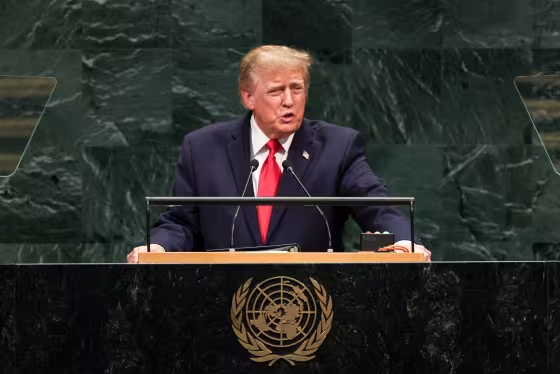
Trump defended the US decision to join Israel in military action against Iran earlier this year. He said Tehran had rejected previous attempts to reach an agreement preventing it from obtaining nuclear weapons.
The US president said he now faced a “big decision” between reaching an agreement with Iran or taking further military action.
“Do I drive them into hell with no chance of survival and no hope of future greatness or generations?” Trump asked.
However, he said he expected an agreement with Tehran after the November US midterm elections.
Trump claimed Iranian leaders were waiting to see how Republicans perform in the elections, while noting that he himself was not on the ballot.
“The Republican Party is running, and I’m going to help them,” he said.
Trump said his main priority remained preventing Iran from acquiring a nuclear weapon.
He also dismissed reports that shortages of US ammunition and interceptor missiles could limit Washington’s military options. Trump said the United States had large weapons stocks and was replenishing them quickly.
He urged other countries to join the US in economically isolating Iran until Tehran stops attacks on commercial shipping, abandons its nuclear ambitions and ends support for terrorism.
Trump cites Gaza war
Trump also referred to Hamas’ October 7, 2023 attack on Israel and accused Iran of supporting those responsible.
He argued that Iran could not be allowed to operate under the protection of a nuclear arsenal.
Trump also presented the Gaza ceasefire as an example of his administration’s ability to turn conflicts into negotiated settlements.
He recalled that the Gaza war was still continuing and hostages remained in captivity when he addressed the General Assembly a year earlier.
Trump said his administration’s 20-point plan had later been endorsed by the UN Security Council, while the Board of Peace was established to oversee the postwar framework.
According to the board, the ceasefire led to the return of all hostages and its current focus is on demilitarisation, Palestinian civilian administration, reconstruction and humanitarian assistance.
Trump thanked Qatar, Kuwait, Saudi Arabia, Turkey and other countries involved in supporting Gaza.
He also praised Indonesia, Morocco, Albania, Kosovo, Kazakhstan, Egypt and Jordan for committing personnel, police or training to Gaza stabilisation efforts.
The Board of Peace is due to meet on the sidelines of the General Assembly to review the implementation of the Gaza framework.
Ukraine, Greenland and Venezuela
Trump gave less attention to Russia’s war in Ukraine, saying his administration continued working to end the conflict.
His schedule after the UN speech included separate meetings with Ukrainian President Volodymyr Zelensky and Gulf leaders. The war with Iran was expected to be discussed during the regional meetings.
Trump was also expected to sign an agreement expanding the US military and commercial presence in Greenland following nearly two years of pressure on Denmark, according to The Wall Street Journal.
He was further scheduled to meet Venezuela’s interim leader, Delcy Rodríguez.
Her government has entered an arrangement giving the Pentagon a role in Venezuela’s oil sector. Trump has said greater US involvement in Venezuelan energy production could help reduce fuel prices in the United States.
The meeting is politically sensitive because Rodríguez previously served as a senior official under Nicolás Maduro, who was removed in a US military operation earlier this year.
Xi summit ahead
Trump’s UN appearance came shortly before Chinese President Xi Jinping’s three-day state visit to the United States.
The Wall Street Journal reported that Trump is seeking a less confrontational relationship with Beijing and wants to avoid deeper economic and military tensions.
The summit is expected to focus heavily on the broader US-China relationship rather than major new agreements.
Trump’s UN address highlighted the tension between his claim of having achieved peace through decisive action and the continuing conflicts involving Iran and Ukraine.
His approach to Iran reflected that contrast, as he threatened Tehran with severe consequences while predicting that diplomacy would eventually produce an agreement.
Secretary of State Marco Rubio said ahead of the speech that Trump remained open to meeting Iranian President Masoud Pezeshkian, while noting that Iran’s supreme leader remains the country’s ultimate decision-maker.
Trump’s message to the General Assembly was that negotiations and the willingness to use military force were both central to his foreign policy.
“While others have spoken of peace,” Trump said, “I have made peace.”