
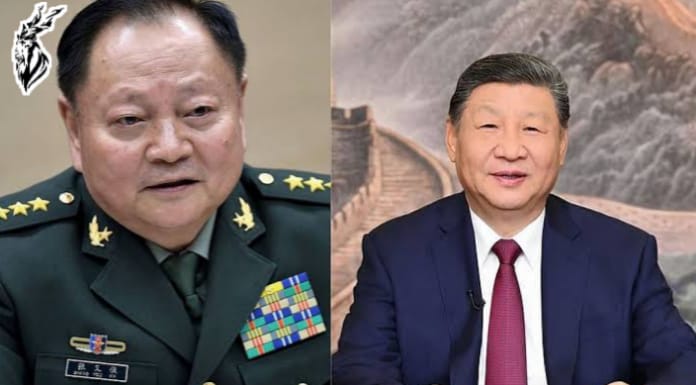

China on Saturday announced that Zhang Youxia, the senior vice chairman of its powerful Central Military Commission (CMC), along with another top military official, is under investigation for suspected “serious violations of discipline” — a phrase widely understood as a reference to corruption and other misconduct.
The latest announcement reflects Beijing’s continued push to tighten internal accountability as part of President Xi Jinping’s sweeping anti-graft campaign, which has targeted officials across the Communist Party and state institutions since he came to power more than a decade ago.
In a statement, the defence ministry said that following a review, authorities had decided to open investigations into Zhang Youxia and Liu Zhenli, adding that both were suspected of “serious violations of discipline and the law.”
Zhang, 75, is regarded as China’s highest-ranking general, serving as the more senior of the CMC’s vice chairmen. He is also a member of the influential Politburo, the Chinese Communist Party’s 24-member executive decision-making body.
Zhang holds the vice chairman title alongside Zhang Shengmin, a senior general associated with China’s highly secretive rocket force. The two are not related. Zhang Shengmin was promoted to the position in October after his predecessor was removed amid another wave of military-related corruption investigations.
Both vice chairmen operate under Xi Jinping, who has served as CMC chairman since 2012, giving him direct command over the armed forces.
Meanwhile, Liu Zhenli, 61, serves as chief of staff of the CMC’s Joint Staff Department — a key institution responsible for overseeing operational planning and combat readiness.
Speculation about a possible probe had intensified earlier this week after Zhang Youxia and Liu were notably absent from an official meeting chaired by Xi, which was attended by other senior military leaders, including Zhang Shengmin.
Xi has repeatedly described corruption as the “biggest threat” facing the Communist Party, warning that the struggle against graft remains “grave and complex.” Supporters of the campaign argue that it strengthens governance and improves discipline within state institutions. Critics, however, contend that it can also function as a political instrument used to remove rivals and consolidate authority.
The investigation announcement follows a series of recent high-profile cases within China’s defence establishment. In October, authorities disclosed that corruption probes had been launched into nine military officials, and the defence ministry confirmed that two senior generals had been expelled from the military as part of those investigations.
Those removed included He Weidong, the former second-ranked CMC vice chairman, and Miao Hua, the former head of the military’s political work department.
China’s military leadership has also faced major upheaval in recent years. In 2024, former defence minister Li Shangfu was expelled from the Communist Party after being removed from office over allegations including suspected bribery. His predecessor, Wei Fenghe, was likewise expelled and referred to prosecutors over alleged corruption.
The latest investigations underscore the ongoing intensity of Xi’s anti-corruption drive — particularly within the military — as Beijing seeks to reinforce discipline and loyalty at the highest levels of the armed forces.