


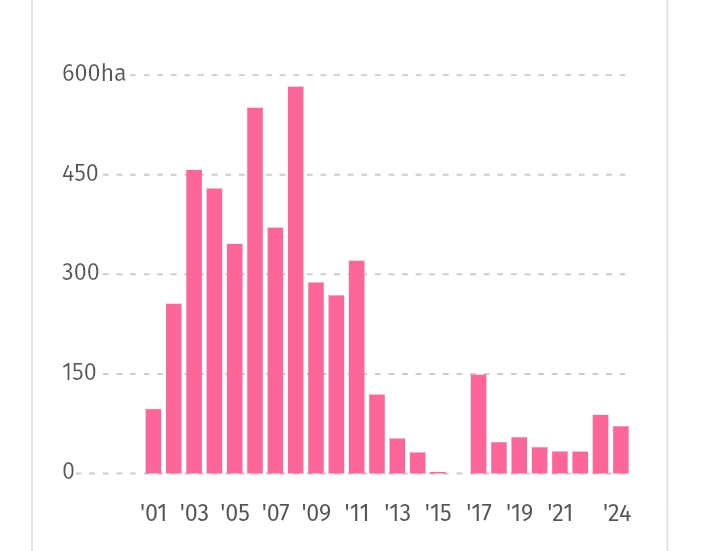
The floods in KPK have, on one side highlighted the climate crisis, and yet again exposed the timber mafia and deforestation in the province. Between 2001 and 2024, Khyber-Pakhtunkhwa (KPK) experienced a significant loss of tree cover, with 4.69 thousand hectares (kha) of forest area disappearing.
This represents a decline of 0.87% from the region’s 2000 tree cover area. Furthermore, this loss of tree cover resulted in an estimated 1.87 million metric tons (Mt) of CO₂ equivalent emissions, highlighting the urgent need for sustainable forest management practices. Note that these figures do not account for any gains in tree cover that may have occurred during this period. (Source; Global Forest Watch)
Swat Valley, often referred to as the “Switzerland of Pakistan,” is a breathtakingly beautiful region nestled in the heart of Khyber Pakhtunkhwa (KPK). The valley’s stunning landscape, replete with snow-capped peaks, lush green valleys, and dense forests of pine and deodar trees, has long been a magnet for tourists and nature enthusiasts from around the world.
However, beneath its serene surface, Swat Valley is facing a grave threat: deforestation and the timber mafia. According to Musawar Khan, CM KPK Adviser for Forests and Climate Change, the Forest Force has been empowered with police-like powers to protect forest resources and conduct operations against the timber mafia under the KP Forest Ordinance of 2002. The Forest Force is equipped with the latest weaponry, vehicles, and communication systems, and has the authority to take drastic measures, including shooting offenders and timber mafia members in self-defense.
Despite these measures, deforestation persists, driven primarily by illegal logging, urban expansion, and infrastructure development.
Satellite images reveal a stark reality: over 8,000 hectares of forest are lost each year, with regions such as Hazara and Malakand witnessing a staggering 25% decline in their green cover over the past two decades.
The consequences of deforestation are far-reaching and devastating. With each tree felled, KP’s vulnerability to landslides, flash floods, and soil erosion grows, leaving communities on the edge of an uncertain future.
The rapid urbanization of cities like Peshawar, Abbottabad, and Swat has also contributed significantly to deforestation, with the province’s urban population growing by nearly 60% between 2000 and 2022.
The National Forest Policy reveals a grim picture: Pakistan’s total forest-covered area stands at a mere 5%, with the country losing around 27,000 hectares of forests per year. Tauheed Khan, former Conservator of Forests, notes that Pakistan’s deforestation rate is alarming, with the country losing forest cover at a rate comparable to global averages.
The implementation of initiatives like the Billion Tree Tsunami (BTT) has done little to curb deforestation, mainly due to weak enforcement of laws. The Forest Ordinance of 2002 has proven insufficient, with loopholes and a slow judicial process allowing timber mafias to exploit the system.
Corruption within enforcement agencies further compounds the issue, enabling offenders to evade significant penalties and continue their destructive activities unchecked.
As KP grapples with the challenges of deforestation and the timber mafia, it is clear that a multi-faceted approach is needed. Stricter enforcement of existing forest laws, increased community involvement, and sustainable development practices are essential to counter the challenges posed by climate change.
The battle to save forests is not just a local issue; it is a national concern that requires immediate attention and action.