
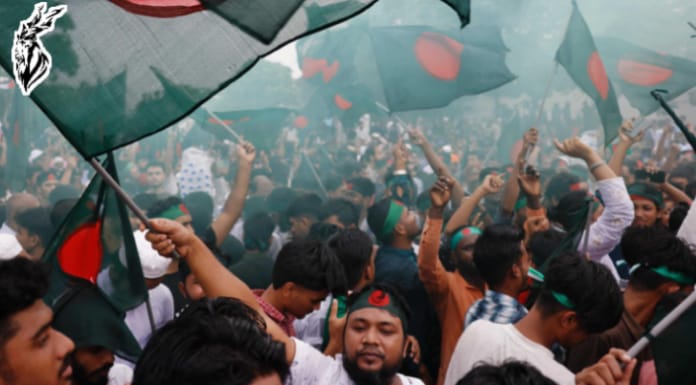

Bangladesh will hold national elections on February 12, almost two years after a student-led uprising in 2024 ended the 15-year rule of Prime Minister Sheikh Hasina and her Awami League party. The vote marks the country’s first attempt to restore electoral politics since that upheaval—and it has drawn close attention from India, Pakistan and China, all of which see Bangladesh as strategically vital.
A post-Hasina political landscape
Bangladesh is currently governed by an interim administration led by Nobel Peace Prize laureate Muhammad Yunus. The election features two main contenders: the Bangladesh Nationalist Party (BNP) and Jamaat-e-Islami (JIB), both of which began campaigning in late January.
Authorities have barred the Awami League from contesting the elections because of its role in the violent crackdown on student protests in 2024, during which security forces killed approximately 1,400 people. Sheikh Hasina, now 78, fled to India following her ouster. In November last year, Bangladesh’s International Crimes Tribunal (ICT) tried her in absentia, found her guilty of authorising lethal force against protesters, and sentenced her to death. India has so far refused to extradite her, triggering deep diplomatic friction with Dhaka.
Hasina has publicly rejected the legitimacy of the upcoming election. In an interview with The Associated Press, she argued that “a government born of exclusion cannot unite a divided nation.”
A “paradigm shift” in foreign policy
Political analysts say Hasina’s removal has caused a fundamental shift in Bangladesh’s geopolitical orientation.
During Hasina’s tenure, Bangladesh:
- Built close and comprehensive ties with India
- Maintained cold and distant relations with Pakistan
- Pursued a strategic but carefully balanced partnership with China in defence, trade and infrastructure
That alignment has now changed.
According to Khandakar Tahmid Rejwan, a lecturer at the Independent University, Bangladesh, relations with India have reached a historic low, while ties with Pakistan have warmed and cooperation with China has intensified.
“This predictive and patterned alignment of Dhaka has now been reversed with respect to India and Pakistan, or revised with respect to China,” Rejwan said.
India’s declining influence
India has emerged as the largest strategic loser from Hasina’s ouster.
New Delhi invested heavily in Hasina personally, to the point where it blurred the distinction between bilateral relations with Bangladesh and support for a single political leader. That approach backfired when Hasina’s government engaged in open election rigging, imposed draconian authoritarian laws, and relied on violent repression to stay in power—all while critics framed India as her principal external backer.
Anti-India sentiment surged after:
- India refused to extradite Hasina
- Protest leader Osman Hadi, a vocal critic of Indian influence, was murdered in 2024
- Large demonstrations targeting India erupted across Bangladesh
Tensions worsened further amid allegations that the interim government failed to protect Bangladesh’s Hindu minority. In December, a Hindu man was lynched in Bhaluka after accusations of making derogatory remarks about Islam, an incident that occurred amid widespread unrest following Hadi’s killing.
Diplomatic and sporting fallout
Relations also spilled into sport. In January, the Bangladesh Cricket Board asked the International Cricket Council (ICC) to relocate Bangladesh’s T20 World Cup matches scheduled in India to Sri Lanka, citing security concerns. The ICC responded by expelling Bangladesh from the tournament.
The Pakistan Cricket Board backed Bangladesh and later announced that Pakistan would boycott its match against India on February 15, highlighting how Bangladesh’s political crisis has rippled across the region.
Michael Kugelman of the Atlantic Council said India became deeply uncomfortable with the interim government, which New Delhi believes operates under the influence of Jamaat and other religious actors that India views as hostile to its interests.
Despite tensions, Prime Minister Narendra Modi and Yunus met on the sidelines of a BIMSTEC summit in Bangkok last year. India publicly reaffirmed its support for a “democratic, stable and inclusive Bangladesh,” and both sides discussed Hasina’s extradition—though India continues to shelter her.
Pakistan’s strategic opening
Pakistan has used Hasina’s removal to rebuild relations with Bangladesh, which remained strained for decades following the 1971 war of independence.
That war followed Pakistan’s creation in 1947 as a two-wing state, with East Pakistan later becoming Bangladesh.
Renewed engagement
Since 2024, Pakistan has:
- Held multiple high-level meetings between Prime Minister Shehbaz Sharif and Yunus
- Resumed direct trade with Bangladesh for the first time since 1971
- Restored direct flights after 14 years, reversing a 2012 suspension over security concerns
- Restarted military and defence dialogue
Analysts say Pakistan seeks to raise India’s security costs on its eastern flank by cultivating closer defence and diplomatic ties with Dhaka. Islamabad and Dhaka have also sought to downplay the legacy of 1971, with rising anti-India sentiment inside Bangladesh being the primary force in shifting the narrative.
Pakistan has strongly promoted the idea of a Bangladesh–China–Pakistan trilateral arrangement, although Dhaka has so far resisted formal participation.
Pakistan and the election
Pakistan would accept either a BNP or Jamaat-led government, but analysts say Islamabad would clearly prefer Jamaat.
A Jamaat government would likely resist closer ties with India and align more easily with Pakistan ideologically. A BNP government, by contrast, would keep channels open with Pakistan but avoid strategic dependence, preferring a “Bangladesh first” policy that hedges among multiple partners.
China’s expanding role
China has approached Bangladesh with consistency and pragmatism, maintaining strong relations regardless of which party holds power.
Since 1975, Beijing has treated Dhaka as a long-term partner. Under both Hasina and Yunus, China has:
- Signed and expanded major economic and infrastructure agreements
- Provided about $2.1bn in investments, loans and grants
- Deepened defence cooperation
- Offered assistance in managing the Rohingya refugee crisis in Cox’s Bazar
Yunus has also discussed the possible purchase of Chinese fighter jets, although no deal has been finalised.
Rejwan said China reacted swiftly and positively to Hasina’s ouster, welcoming the interim government and expanding engagement under the new political reality.
How China views the election
China has taken a hands-on but non-partisan approach to the election. Over the past year, Chinese officials have met leaders from Jamaat, BNP and other political parties, discussing post-election cooperation.
Beijing views Bangladesh as:
- A key trade and investment hub
- A strategic foothold in South Asia, long considered India’s sphere of influence
China prioritises:
- Political stability
- Protection of Chinese investments and personnel
- Limiting US influence over Bangladesh’s future leadership
Unlike India, China avoids overt interference and prefers inclusive engagement with all major political actors.
Why this election matters
The February vote will decide far more than Bangladesh’s next government.
It will determine:
- Whether India can recover lost influence
- Whether Pakistan can institutionalise its diplomatic comeback
- How deeply China embeds itself in South Asia’s political and economic architecture
For Bangladesh, the election represents a critical attempt to restore democratic legitimacy after years of repression and unrest. For the region, it may reshape South Asian geopolitics for years to come.