
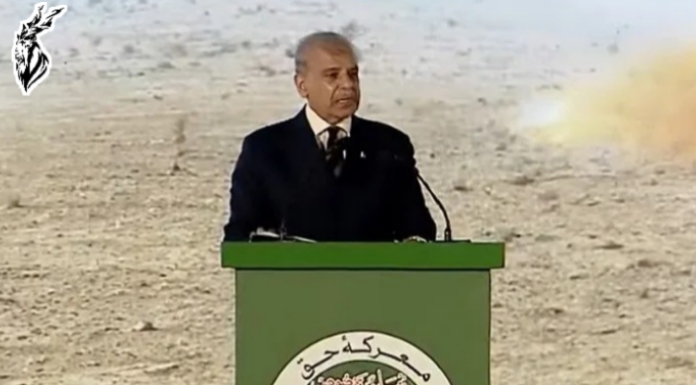

Shehbaz Sharif said on Sunday that Pakistan’s decisive military response during Marka-e-haq compelled New Delhi to seek a ceasefire, while praising the armed forces for their performance in what he described as a historic victory.
The prime minister made the remarks during a ceremony held at the Pakistan Monument to mark the first anniversary of “Marka-e-Haq” — the 19-day military confrontation between Pakistan and India that lasted from April 22 to May 10, 2025.
The event was attended by Asif Ali Zardari, military chiefs, senior government officials, and political leaders.
Before addressing the audience, PM Shehbaz observed a one-minute silence to honour those who lost their lives defending the country during the conflict.
In his speech, the premier rejected India’s allegations related to the Pahalgam incident, calling them baseless and stating that Pakistan had repeatedly offered an impartial investigation into the matter. He said Pakistan had warned India against any military adventurism but was ultimately forced to respond after what he described as Indian aggression.
According to the prime minister, Pakistan’s armed forces delivered a strong and effective response during the conflict, with the air force dominating the skies and inflicting heavy losses on the enemy. He claimed the military pressure eventually forced India to seek a ceasefire.
PM Shehbaz also noted that India had yet to provide evidence supporting its accusations against Pakistan, even a year after the incident.
Declaring May 10 as “Youm-e-Marka-e-Haq,” the prime minister announced that the day would now be observed annually to commemorate the country’s military response and national unity.
He praised Asim Munir for his leadership during the conflict and also commended the chiefs of the Pakistan Air Force and Navy for their roles in defending the country.
The premier said the nation’s 240 million citizens had stood united behind the armed forces throughout the crisis. He also thanked friendly nations for supporting Pakistan diplomatically, including Mohammed bin Salman, Recep Tayyip Erdoğan, and Xi Jinping.
He additionally acknowledged the role of Donald Trump in helping ease tensions between Pakistan and India.
The prime minister also referred to Pakistan’s ongoing diplomatic efforts in the Middle East, saying Islamabad continued to support mediation initiatives aimed at ending regional conflicts. He disclosed that he had been briefed on Iran’s response to a US proposal concerning the war but did not share further details.
Meanwhile, President Zardari described May 10 as a “golden chapter” in Pakistan’s history and paid tribute to the armed forces for what he called a befitting response to Indian aggression.
He accused India of targeting civilian populations and places of worship during the conflict and claimed Pakistan’s military had shot down eight Indian fighter jets. The president said the armed forces had elevated the nation’s pride through their actions.
Reaffirming Pakistan’s position on Indian Illegally Occupied Jammu and Kashmir, President Zardari said Pakistan would continue extending political, moral, and diplomatic support to the Kashmiri people.
He also alleged that India was supporting terrorism inside Pakistan through Afghan territory and called for an end to such activities.
Addressing the situation in Gaza and the Occupied West Bank, the president reiterated Pakistan’s support for the Palestinian people and condemned ongoing Israeli actions in the region.