
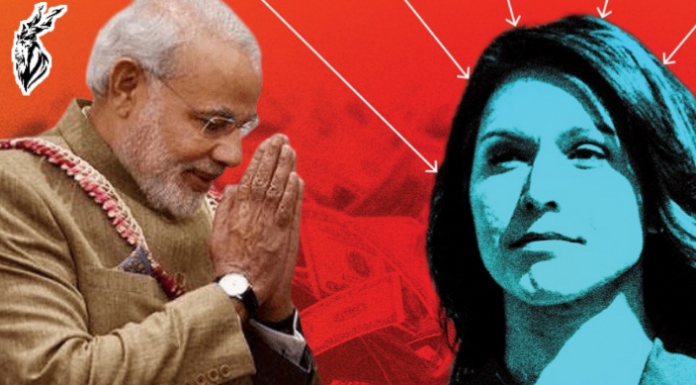

Tulsi Gabbard, whose political journey took her from progressive Democratic congresswoman to one of the most senior intelligence officials in the Trump administration, announced her resignation as Director of National Intelligence, effective June 30, citing her husband’s recent diagnosis with bone cancer.
“His strength and love have sustained me through every challenge,” Gabbard wrote in her resignation letter, obtained by CBS News. “I cannot in good conscience ask him to face this fight alone while I continue in this demanding and time-consuming position.”
President Donald Trump praised her departure with characteristic warmth. “Tulsi has done an incredible job, and we will miss her,” he wrote on social media. Aaron Lukas, the principal deputy director, will serve as acting director following her exit.
The resignation closes a remarkable and often contradictory chapter in American political life. Gabbard first rose to national prominence as a Hawaii congresswoman — the first Hindu elected to the U.S. Congress — whose 2016 resignation from the Democratic National Committee to endorse Bernie Sanders made her a darling of the progressive left. She went on to collect endorsements from groups like Progressive Democrats of America and Our Revolution, and repeatedly sailed to re-election in her Honolulu-area district.
Yet even during those progressive years, questions trailed her about her ties to Hindu nationalist networks in the United States. Reporting from 2019 detailed how pro-Modi elements of the Hindu-American diaspora — some with links to the RSS and affiliated organizations — had donated generously to her campaigns and cultivated her as an ally. As a member of the House Foreign Affairs and Armed Services committees and co-chair of the India Caucus, she was a strategically valuable friend. She publicly distanced herself from those backers on at least one occasion, even as she continued engaging them privately, according to that reporting.
Her political evolution ultimately carried her far from the left. She left the Democratic Party, aligned herself with Donald Trump, and was appointed to lead the nation’s intelligence community — one of the most powerful and sensitive positions in the federal government.
Now, with her husband’s health forcing her hand, that chapter too is over. What comes next for one of American politics’ most shape-shifting figures remains an open question.