
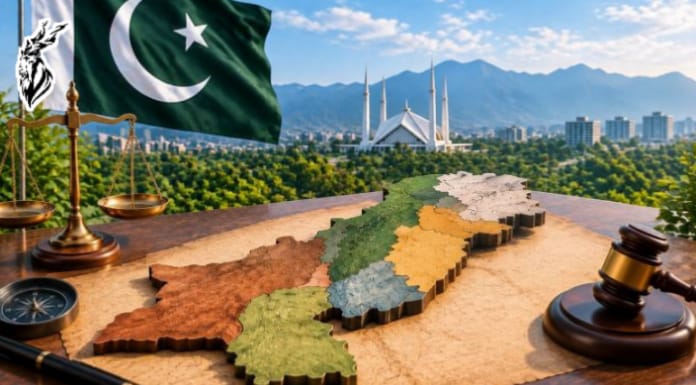

Pakistan needs administrative restructuring because its current map carries a population load it was never designed for. The country is now home to more than 240 million people, yet the spaces where political power, financial decisions and government action are concentrated remain very few.
The scale of the imbalance is stark. Punjab alone is home to over 127 million people, Sindh more than 55 million and Khyber Pakhtunkhwa over 40 million. These numbers matter beyond being a headcount from a census. They help decide how far the government has to reach, how many people local institutions must serve, how development funds are shared and how fast the state can act.
At the national level, Pakistan has only 266 directly elected National Assembly seats for a population of 241.5 million, averaging roughly one directly elected representative for every 908,000 people. That is a heavy load for any single lawmaker, and it inevitably shapes how responsive the system can be.
The problem is not only numeric. Government is heavily concentrated in Lahore, Karachi, Peshawar and Quetta. Ministries, senior bureaucracies, large hospitals, universities, courts and development authorities gather around provincial capitals. Over time, economic activity follows them, as do jobs, professional services, infrastructure and investment.
Such concentration has consequences for regions farther away. A citizen in southern Punjab experiences provincial government differently from someone in Lahore. The same holds for Hazara in relation to Peshawar, or for distant districts in Sindh and Balochistan. Geography eventually becomes administrative distance. Files move through longer chains, senior decision-makers remain elsewhere and development priorities compete for attention with those of much larger metropolitan centres.
This is exactly why the debate over new administrative units deserves to be linked directly with prosperity. In economics, government exerts a gravitational pull. A centre of administration creates surrounding departments, courts, universities, hospitals, infrastructure, housing, services and jobs, and this draws businesses towards it. It also fosters professional communities and a concentration of skills that smaller, distant districts struggle to build on their own.
When that pull is absent, the consequences compound. Young people migrate to the few big cities in search of education and work. Local economies remain underdeveloped. Public services stay thin. The state becomes something that is visited or petitioned from a distance rather than experienced as a daily presence. That is a recipe for uneven citizenship and mounting frustration.
Administrative restructuring, in this context, is not merely about drawing new lines on a map. It is about shortening the distance between the governed and those who govern. It is about placing decision-makers, courts, hospitals and development authorities closer to the populations they serve. It is about giving regions that are currently hinterlands a real administrative centre of their own, with the institutions and spillovers that follow.
There are legitimate questions about cost, capacity and political consensus, and those must be addressed honestly. But the status quo is not neutral. It preserves a structure built for a much smaller country and a different era. With more than 240 million people and only a handful of concentrated power centres, the current arrangement is struggling to deliver both representation and growth.
Pakistan needs administrative restructuring because the alternative is a state that remains distant from too many of its citizens. The debate over new units is ultimately a debate about how prosperity is spread, how services reach people and how the country manages its own size. Ignoring that debate will not make the pressures go away.
Source: Dawn News