
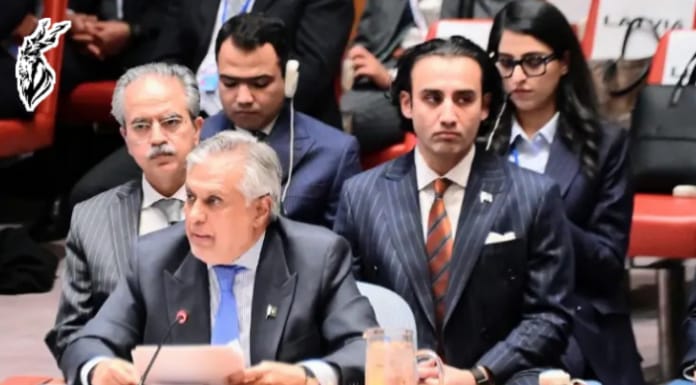

Pakistan has told the United Nations Security Council that artificial intelligence must not become another facet of the ongoing arms race, urging concerted global action to build guardrails around a technology that is reshaping international security. The statement was delivered by Deputy Prime Minister and Foreign Minister Ishaq Dar during a France-chaired briefing on artificial intelligence and international security, where leaders of major AI firms briefed the top UN body.
Dar warned that without restraint, AI could deepen existing strategic rivalries and introduce new dangers into the military domain. “We must ensure that AI does not become another facet of the ongoing arms race,” he said, according to a statement shared by the Foreign Office on Thursday.
The deputy premier called for “concerted efforts” to erect the necessary guardrails, regulations and governance frameworks. In the military sphere, he said, measures of restraint and confidence-building are needed to address the risks of miscalculation and compressed decision-making.
Dar placed human judgment at the centre of Pakistan’s position, stating that the foremost priority is to retain human judgement and control in all stages of AI design, development and integration. Humans, he argued, must remain in control to define the structures of AI systems and to limit the speed and nature of future capabilities.
The briefing drew senior executives from the world’s leading AI companies. OpenAI CEO Sam Altman, Anthropic CEO Dario Amodei, Hugging Face CEO Clement Delangue and Yoshua Bengio, co-chair of the UN International Independent Panel on AI, all addressed the council. Amodei pledged to slow down where needed to ensure the safety of new releases, while Altman said “this moment calls for extreme care”.
Dar further cautioned that the technology should not become a monopoly of a few actors, calling for international collaboration in AI development. He noted that AI was supercharging existing challenges such as misinformation, fake news and cyber attacks, including on critical infrastructure by state and non-state actors.
“We must undertake concrete action to address the gaps and challenges that carry huge implications for peace and security,” he said.
The meeting reflects growing concern at the UN that rapid advances in AI are outpacing international rules, particularly as the technology is integrated into military planning and decision-making. Pakistan’s intervention places it among states pressing for governance mechanisms that balance innovation with restraint.
As the Security Council weighs its next steps, Pakistan’s message was clear: AI must not become another facet of the ongoing arms race, and human control must remain paramount. The coming months will test whether the council can translate those warnings into concrete measures.
Source: Dawn News