
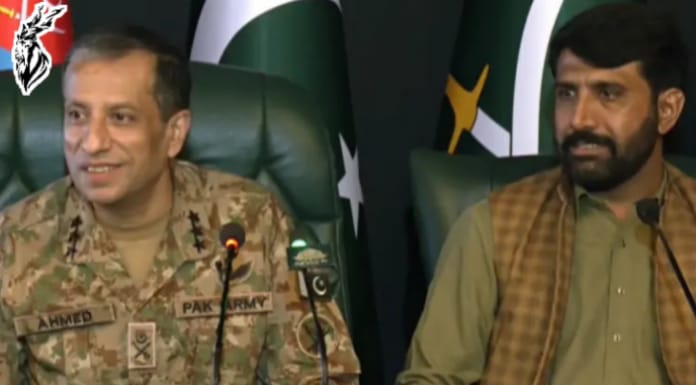

The Pakistan Army on Thursday produced a retired soldier who is alive in Pakistan, publicly debunking India’s claim that he had been killed as a senior militant commander in Indian Illegally Occupied Jammu and Kashmir (IIOJK). Inter-Services Public Relations (ISPR) Director-General Lt Gen Ahmed Sharif Chaudhry presented Havildar Muhammad Asif, a former Special Services Group (SSG) commando, before the media in Rawalpindi, comprehensively demolishing what the military described as another Indian false-flag operation.
Addressing a press conference, the ISPR DG said the incident began on the night of September 29, when the Indian Corps posted on social media that a joint search operation had been launched in the general area of Korag, Yousmarg, during which one “terrorist” had been neutralised. Nearly seven hours later, the Indian Army issued an update claiming that the body of a Lashkar-e-Taiba operative identified as Mohammad Asif alias Hashim Moosa had been recovered along with war-like stores in the general area of Palmaidan.
Shortly afterwards, Indian news agency ANI published a detailed account claiming Mohammad Asif was born on March 7, 1980, had joined the Pakistan Army in 2000 under service number PA-3106947, retired with the rank of Havildar, was inducted into the Special Services Group in 2005, served with 4 Commando Yalgar Battalion, was posted to Balochistan from 2006 onward, participated in approximately 10 operations against Baloch insurgents, was credited with 13 kills and had served on the VVIP security team of former President Pervez Musharraf between 2006 and 2009.
“You might be recalling Uri, Pahalgam and Pulwama — a very interesting story is being cooked, and the story is now complete,” the ISPR DG said, adding that there was a lot of evidence available. He then produced Havildar Muhammad Asif — alive in Pakistan and seated before the assembled media — exposing another in a series of staged incidents designed to manufacture a Pakistani militant narrative in IIOJK. Chaudhry noted that India had claimed Asif was involved in attacks in different areas, and that he was a retired SSG Havildar.
Speaking alongside the military’s spokesperson, Asif said he is a resident of Tehsil Pindigheb, Attock District. “Yesterday evening, I received phone calls from friends informing me that Indian media and social media platforms were reporting that the Indian Army had killed me in an encounter in Kashmir. They asked me where I was. I told them that I was alive and well, sitting at home, Alhamdulillah.”
Soon after, he said he started receiving calls from unknown Indian numbers inquiring about his personal details and asking whether he was related to the person mentioned in the news. “I repeatedly blocked those numbers. Shortly afterwards, I saw news broadcasts showing my photograph and personal military record, claiming that I had been martyred in Kashmir,” the ex-SSG commando said. “I was utterly astonished. I was sitting at home, yet they were claiming to have killed me in Kashmir.”
Asif said he immediately informed his former unit leadership to clarify that he was safe and at home, so that no false impressions or accusations could be created. “They advised me to block the calls and informed me that the ISPR would contact me to present the truth.” He added that when the ISPR reached out and asked about the situation, he confirmed he was alive, and they requested him to come forward and state the facts publicly.
Providing his background, Asif said he enlisted in the Pakistan Army’s Artillery Corps in 2000, joined the SSG in 2005, and served with honour and dedication for 18 years before retiring. The military spokesperson said the armed forces are “always prepared” for the enemy, and accused India of externalising its internal problems through such claims.
The episode adds to a pattern of contested incidents between the two nuclear-armed neighbours, with Pakistan repeatedly rejecting Indian assertions of cross-border militancy. For Islamabad, the public appearance of a man Delhi claimed to have killed serves as stark rebuttal — and a reminder that the information battle between the two countries is as fiercely contested as any on the ground.
Source: Geo News