
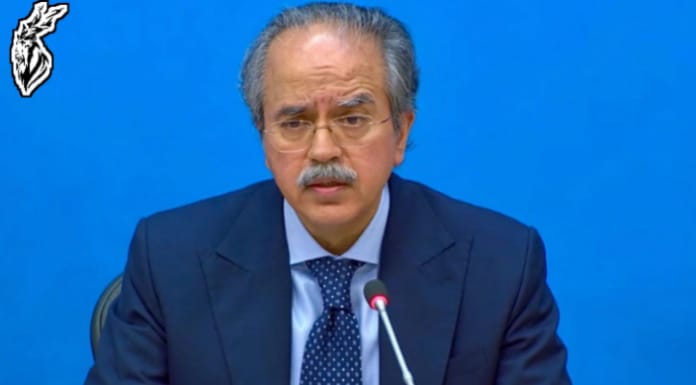

Pakistan opposes the addition of new permanent members to the United Nations Security Council and instead supports expanding the number of elected, non-permanent seats on the 15-member body. Ambassador Asim Iftikhar Ahmad, Pakistan’s permanent representative to the UN who is set to take charge as the country’s new foreign secretary, outlined this position in an interview with Dawn while assessing Pakistan’s 2025-26 term on the Council.
Mr Ahmad is returning to Islamabad after serving as Pakistan’s envoy to the world body and will assume the role of foreign secretary next week. Reflecting on his tenure, he discussed the major international crises and diplomatic initiatives that shaped Pakistan’s latest stint on the Security Council, its eighth tenure overall. For Mr Ahmad personally, it was his third consecutive Council assignment.
“Developments in recent years in the peace and security landscape and within the Security Council, as well as increased criticism of the role of the permanent members, have further reinforced the belief of a wide majority of member states that we need a more democratic, representative and accountable Security Council,” he said. “Adding any new individual permanent members would only aggravate the problem. In simple words, the problem cannot be the solution.”
Pakistan has advocated, along with members of the Uniting for Consensus group and other like-minded countries, a reformed Council with more elected members, including medium-term seats based on periodic elections and rotation. Mr Ahmad argued that Pakistan and many other countries are eminently qualified to contribute to the Security Council and the maintenance of international peace and security.
“Member states should be ready to fulfil that responsibility without permanence and privilege,” he said, underscoring Pakistan’s long-standing position that expansion of permanent membership would undermine the Council’s democratic legitimacy.
Beyond the question of structural reform, the foreign secretary-designate highlighted Pakistan’s broader role in peaceful dispute settlement. He noted that Islamabad continues to press for a peaceful resolution of the Kashmir dispute, a position the country has consistently advanced in international forums. The emphasis on dialogue and diplomacy, he suggested, reflects Pakistan’s commitment to the principles of the UN Charter and its opposition to unilateral actions that threaten regional stability.
Pakistan’s opposition to new permanent seats places it alongside a bloc of nations that argue the Council’s current composition no longer reflects contemporary geopolitical realities. Critics of the permanent five — the United States, Russia, China, France and Britain — contend that the veto power held by these members has repeatedly paralysed the body’s response to crises. Yet the debate over how to reform the Council remains deadlocked, with rival proposals for expansion competing against one another.
For Pakistan, the solution lies not in replicating the existing privilege structure but in broadening representation through elected membership. Mr Ahmad’s remarks signal that Islamabad will continue to champion this approach as he transitions from his UN role to the helm of the Foreign Office, where he will oversee Pakistan’s diplomatic engagements on multiple fronts.
Pakistan’s stance reflects a wider frustration among many UN member states who believe the Security Council must evolve to remain credible. As Islamabad prepares for a new phase in its foreign policy leadership, its advocacy for a more accountable and representative Council — and for peaceful settlement of disputes such as Kashmir — is likely to remain central to its international agenda.
Source: Dawn News