
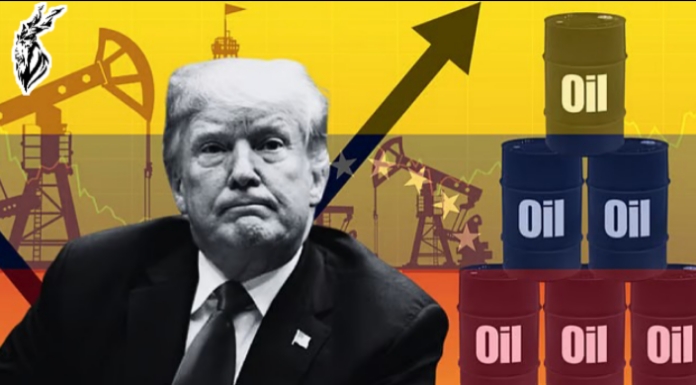

Global financial markets convulsed on Thursday as President Donald Trump’s renewed threats against Iran sent oil prices soaring and equity markets tumbling worldwide. In a prime-time address that dashed hopes for a quick resolution to the Middle East conflict, Trump vowed to intensify U.S. strikes against Iran “over the next two to three weeks,” sending Brent crude surging more than 7% to $109.60 per barrel.
The president’s stark reversal came just one day after suggesting to Reuters that the U.S. would be “out of Iran pretty quickly.” This sudden shift in rhetoric triggered a wave of selling across global markets, with Asian stocks bearing the initial brunt. Japan’s Nikkei index plunged 2.4%, while South Korea’s Kospi plummeted 4.7%, reflecting the vulnerability of energy-intensive technology sectors to oil price shocks.
European and U.S. markets followed suit, with the pan-European FTSEurofirst 300 index dropping 1.3% and Wall Street futures pointing to similar declines. Only energy stocks bucked the trend, with Exxon Mobil and Chevron both gaining about 3% as investors sought refuge in the sector that has consistently gained since the conflict began.
“The only thing that really matters is whether the Strait of Hormuz will open soon,” said Prashant Newnaha, senior rates strategist at TD Securities, referring to the critical shipping chokepoint through which a fifth of global oil passes. “Trump’s speech doesn’t imply this is likely to happen as quickly as the markets were expecting.”
Government bond yields surged globally on expectations that spiking inflation would force central banks to maintain or raise interest rates. Ten-year U.S. Treasury yields climbed 5 basis points to 4.376%, while benchmark European yields rose to just over 3%. The dollar strengthened as investors sought safe-haven assets, pushing the euro down 0.5% to $1.1526 and sterling below $1.32.
The renewed market turmoil highlights the fragile nature of recent optimism about conflict resolution. According to Reuters analysis, Tehran and Washington have exchanged contradictory statements over the past 48 hours, creating confusion about the conflict’s trajectory. While some signals suggested potential de-escalation, military action has continued unabated.
Emerging markets dependent on oil imports showed increasing signs of strain. India’s central bank took emergency measures to support the rupee, banning trading of certain currency derivatives after the currency hit record lows against the dollar. The intervention provided temporary relief, sending the rupee up 2%, though analysts questioned the sustainability of the rebound.
Gold and silver, which had seen modest gains in recent days, fell sharply as the dollar strengthened. Gold dropped 3% and silver plunged 5.7%, while the dollar index climbed back above 100.05 after dropping nearly 1% earlier in the week.
The market reaction underscores how the Middle East conflict, and the resulting 80% surge in oil and natural gas prices this year, continues to dominate investor concerns. With Trump explicitly stating that “boots on the ground” remain an option and threatening to target Iranian infrastructure, markets face continued uncertainty about both the conflict’s duration and its economic consequences.
As BBC News has reported, the conflict’s economic impact extends far beyond the Middle East, affecting everything from global inflation to emerging market stability. With oil prices now approaching $110 and no clear resolution in sight, financial markets appear braced for continued volatility in the weeks ahead.
Source: ARY News