
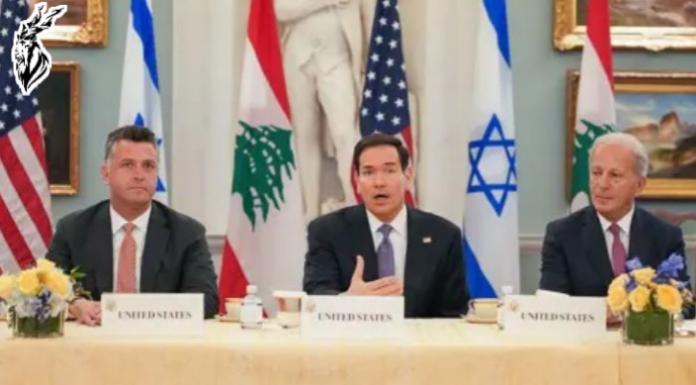

In a landmark diplomatic breakthrough, the United States has facilitated high-level direct talks between Lebanon and Israel, signaling the most significant step toward bilateral peace in over three decades. The meeting, hosted at the State Department in Washington D.C. on Tuesday and chaired by Secretary of State Marco Rubio, brought together the Lebanese and Israeli ambassadors for discussions described by officials as “historic” and “constructive.” This engagement marks the first major senior-level dialogue between the two governments since 1993, raising cautious optimism for a potential comprehensive peace agreement brokered by the U.S.
The talks focused on improving bilateral relations, opening sustained channels of communication, and addressing long-standing regional instability. A joint statement issued afterward emphasized Lebanon’s commitment to asserting full state authority and curbing external influence, including that of Hezbollah, while the U.S. reaffirmed Israel’s right to self-defense against attacks by the group. The statement also stressed the urgent need for full implementation of the 2024 ceasefire, highlighting the fragile security context in which these negotiations occur.
Secretary Rubio characterized the moment as a “historic opportunity,” acknowledging decades of complex conflict but underscoring the significance of renewed engagement. “This effort goes beyond maintaining a ceasefire,” Rubio stated. “It aims to address the long-standing instability linked to Hezbollah’s influence over the past two to three decades. We now have a framework that allows for future progress.” The U.S. role as mediator reflects its ongoing diplomatic efforts in the Middle East, building on previous agreements and ceasefire mechanisms.
Israeli Ambassador Yechiel Leiter told reporters that the Washington talks demonstrated alignment between Lebanon and Israel on several key issues, noting that both countries share a common goal of achieving peace. The discussions are seen as a potential precursor to broader negotiations that could address territorial disputes, security arrangements, and economic cooperation. However, analysts caution that significant hurdles remain, particularly regarding Hezbollah’s political and military presence in Lebanon and ongoing tensions along the Lebanon-Israel border.
The talks represent a delicate diplomatic balancing act, as the U.S. seeks to leverage its influence to foster stability in a region marked by protracted conflicts. While the immediate outcomes are modest—centered on dialogue facilitation and confidence-building—the engagement itself breaks a longstanding diplomatic impasse. As both sides express willingness to continue discussions under U.S. auspices, the international community watches closely, hopeful that this initiative could eventually translate into a durable peace framework, reducing regional tensions and opening new avenues for cooperation.
Source: ARY News