
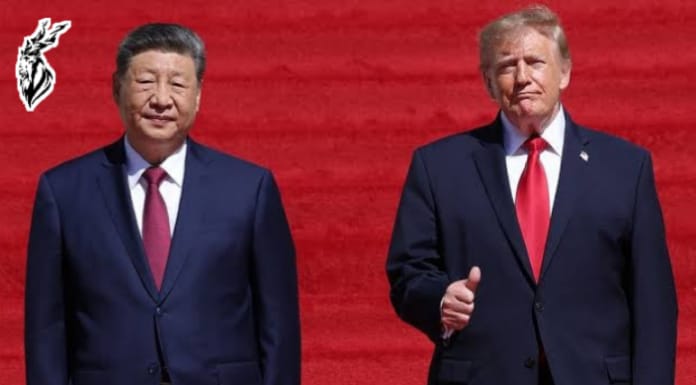

The United States and China will set up a communication channel for artificial intelligence incidents, the White House said on Friday, following a summit between US President Donald Trump and Chinese President Xi Jinping.
The two leaders concluded their talks with a focus on the rising challenges posed by AI, according to a White House fact sheet. As part of the outcome, the two countries established a “U.S.-China Super Intelligence (SI) Dialogue to exchange views on risks and benefits” of artificial intelligence. The White House noted that both leaders had agreed to use the term SI rather than AI. The next exchange under the dialogue is set to occur by November, it added.
In addition to the dialogue, Washington and Beijing agreed to establish a “bilateral communication channel” for incidents related to artificial intelligence. The White House did not provide further details on how the channel would operate or what specific incidents it would cover.
Before the summit, Trump said on social media that “Super Intelligence (SI) will be a big topic of discussion, but I want to leave it exactly where it is.” He added that this was also China’s position. Trump’s comments suggested a cautious approach to the rapidly evolving technology.
Xi, meanwhile, took a more measured tone. Speaking at the White House on Thursday, he called for the United States and China to manage their superpower rivalry and keep artificial intelligence under human control. “We have both the capability and responsibility to develop and manage AI for good and ensure that the development of AI is always under human control,” Xi said.
The summit between the two leaders marked a rare moment of direct engagement on a topic that has increasingly become a point of both competition and potential cooperation. The establishment of a communication channel for AI incidents signals a shared recognition of the risks posed by advanced artificial intelligence systems. While the specifics of the channel remain unclear, its creation suggests that both nations see value in maintaining open lines of communication to prevent misunderstandings or escalations related to AI.
The White House fact sheet also indicated that the two sides would continue to exchange views on the risks and benefits of artificial intelligence through the newly formed dialogue. The next meeting is expected by November, though no exact date was provided. The decision to use the term “Super Intelligence” instead of “AI” reflects a deliberate framing by both leaders, though the reasoning behind this choice was not elaborated.
The agreement to set up a communication channel for artificial intelligence incidents comes amid growing global attention to the safety and governance of AI. Both the US and China are major players in the development of advanced AI technologies, and their cooperation or lack thereof could have significant implications for international norms and standards. The summit outcome suggests a willingness to engage on these issues, at least at the leadership level.
As the two countries move forward with the SI Dialogue and the communication channel, the international community will be watching closely to see how these mechanisms function in practice. The White House has not announced further details about the timeline or structure of the dialogue beyond the November exchange.
The conclusion of the summit leaves open questions about the concrete steps that will follow. Nevertheless, the establishment of a bilateral communication channel for AI incidents represents a notable development in the relationship between the world’s two largest economies. Both leaders have now publicly acknowledged the importance of managing artificial intelligence responsibly.
Source: ARY News