
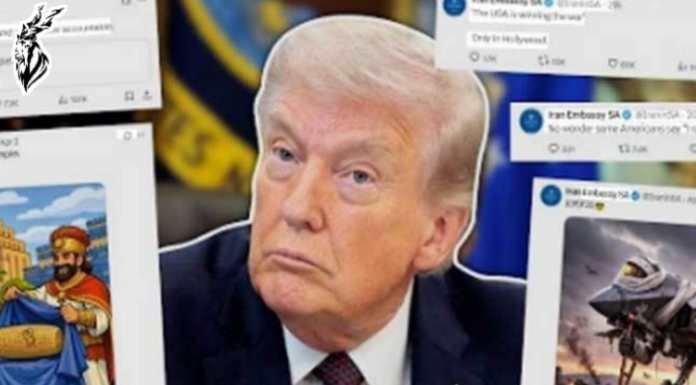

The 2026 military confrontation between the United States and Iran revealed a new paradigm in modern warfare: alongside drone strikes and missile exchanges, a parallel battle for global public opinion raged across social media platforms. What analysts have termed “meme warfare” emerged as a critical digital frontline, where viral humor, AI-generated content, and psychological operations proved as strategically significant as traditional military tactics in shaping the conflict’s narrative.
The kinetic conflict ignited on February 28, 2026, when a joint US-Israeli operation launched approximately 2,000 strikes targeting Iranian nuclear facilities and military infrastructure. President Trump justified the action as necessary to eliminate imminent threats, but the escalation resulted in the death of Iran’s Supreme Leader and significant casualties on both sides. As missiles flew, a different kind of ammunition began circulating online.
Iranian digital operatives, primarily from the Islamic Revolutionary Guard Corps (IRGC) and linked agencies, deployed what analysts called an “AI-powered meme machine.” Viral videos depicted US and Israeli leaders as sweating Lego figurines, with one notorious clip showing a Lego version of Donald Trump being blackmailed with references to the Jeffrey Epstein case just before a missile launch. These memes served dual purposes: maintaining domestic morale while mocking the moral standing of US leadership during retaliatory exchanges.
On the American side, the administration employed what critics labeled “slopaganda”—AI-augmented videos blending real footage of explosions at Iranian bases with pop-culture icons. One widely shared White House clip featured the “Wanna see me do it again?” meme juxtaposed with strike footage, igniting fierce debate about the gamification of warfare. As reported by BBC analysis, this approach reflected a calculated strategy to frame military actions through familiar internet culture while undermining Iranian narratives.
The digital tension extended to diplomatic channels, with Iranian embassies employing sarcastic responses to official demands. When President Trump ordered Iran to open the Strait of Hormuz, the Iranian embassy in Zimbabwe famously replied on X: “We’ve lost the keys. Shh… the keys under the flowerpot. Just open for friends.” This blend of geopolitical messaging and internet humor exemplified how traditional diplomacy had adapted to the meme warfare environment.
The conflict reached a turning point on April 8, 2026, when Pakistan’s Prime Minister Shehbaz Sharif utilized social media to announce a 10-point de-escalation plan that successfully brokered a ceasefire. His tweet announcing the agreement between “the Islamic Republic of Iran and the United States of America, along with their allies” marked a rare instance where digital diplomacy facilitated tangible conflict resolution. As Reuters documented, the ceasefire brought a precious two-week pause to hostilities that had brought the region to the brink of wider war.
As negotiators prepare for talks in Islamabad, the legacy of this conflict’s digital dimension remains clear: while memes can simplify complex geopolitical crises into digestible viral content, they cannot heal the wounds of war. The creativity weaponized for mockery must now be redirected toward building sustainable peace, proving that in the information age, narrative control has become inseparable from military strategy.
Source: ARY News